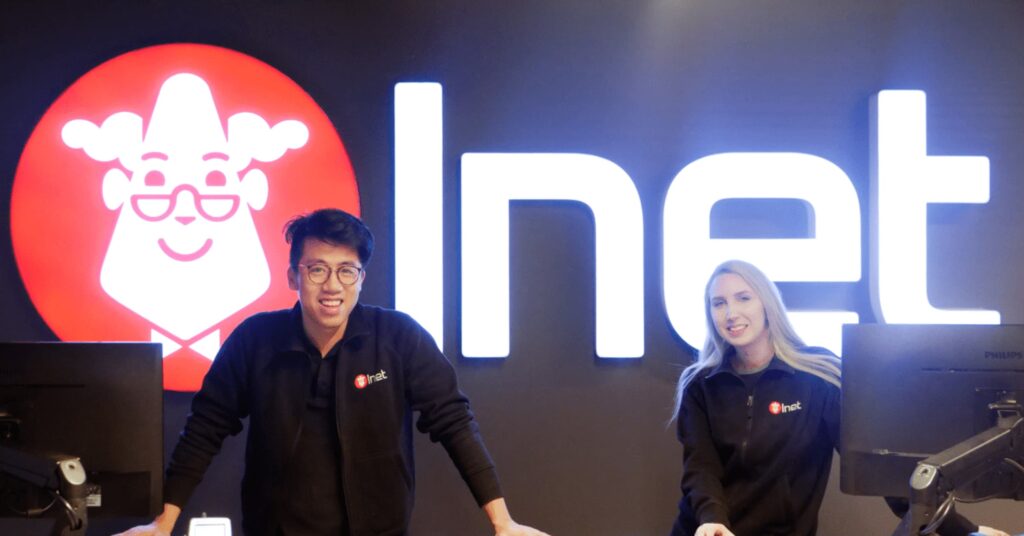
Inet wants to elevate software development to a more professional level
Group dynamics
The primary goal was group dynamics. Key developers had resigned in a short period of time, so it was crucial to keep the group together to prevent more people from leaving and to help the team come together and work in the same direction.
Modern development
To get the most value delivered from the development group, changes are needed in working methods, mindset, infrastructure, and how the organization sees itself. To make the transformation to DevOps, it’s not just the IT and development departments that need to act. The entire company must realize they are a software company that, in this case, sells technical products.
As part of this, the developers, Product Owner, IT, and CTO visited Xenit, Lindex, and Devies to get a glimpse of how modern development works in reality, and the visitors could ask questions.
Stock listing
Inet will be listed on the stock exchange in 2022, which means the requirements for IT and software development will be higher. Higher demands will be placed on security, availability of critical systems, and transparency in working methods.
CTO-as-a-service
Cultural guidance
Work with a leadership style that enables developers’ full capacity, lead by example, and stimulate and reward engagement, new thoughts, and ideas. Don’t micromanage, delegate half-heartedly, or come with pre-written tasks. As leaders, we bring a problem to the developers and they solve it in the best way.
Together with the CTO, we created a persona of what Inet expects from a developer at Inet. This persona will be the basis for salary, personal development, and support in discussions.
We also encourage working in an MVP (Minimum Viable Product) manner. Constantly collect facts about the changes made and make the next decision from there.
Technical guidance
We’ve had discussions about the existing technical platform and future technology choices. Inet’s technology needs are very inconsistent. There are times when a lot of power is needed, but longer periods when the need is consistent. This has led to discussions about which technical platform Inet should invest in for the future.
Furthermore, automation and infrastructure as code have been important points for future technology choices.
CTO-as-a-Service
Don’t hire a CTO-rent one. Get strategic guidance, technical leadership, and high-level decision-making without the full-time salary. Fractional or project-based.
We do tech due diligence, team mentorship, architecture planning, and roadmap alignment.
Developers
History
Previously, developers were very isolated when it came to collaboration. Often developers had little idea what their colleagues were doing. There was also “top-down management” from the CTO who mostly distributed tasks to developers.
There were no clear “Ways of Working” between developers, which meant developers often assumed instead of finding out the facts. At the same time, developers made very large changes to the system, which meant code review and deployment took a long time and became difficult. This work didn’t directly provide any value to customers or the organization since it was done in the backend.
This way of working led to very low morale in the group because nothing left the board, and for each iteration, new commitments were added.
First steps toward modern development
To get a current picture, Devies started by interviewing everyone in the group individually, listening to the group’s tone toward each other at standups and meetings.
After that, a plan was created for how developers should work toward the company’s goal of elevating software development to a more professional level. The rough plan is for the development department to approach DevOps thinking in the cloud in selected parts of the system. This allows the transition to DevOps to be taken in small controlled steps, and Inet as an organization doesn’t need to decide on cloud, on-premises, or hybrid solution today.
Devies gave presentations on how other companies work with software development. This included integration and deployment pipelines, automation, and working with the five ideals.
Perhaps most important of all was getting the developers’ desire to experiment going. As a company, you want developers to be driving and come up with ideas for improvements (both technical and economic), see value in what they’re working on, and make small changes that have big impact. We therefore took the group on study visits to Devies headquarters, Xenit, and Lindex to show how successful companies work with the culture around software development.
At the start, we cleared the board and the entire group got to work focused on solving one larger task. Quick wins were that morale improved as the previously slow flow got going and things started getting done. Additional wins were that PR only became a formality since developers work in pairs or more, knowledge transfer became much greater.
To get faster results in modern thinking around software development, Devies placed two software developers in the group. This gave us a natural influx of modern mindset into the group. This has made team members open up and challenge themselves in how they’ve worked before and that there are alternative ways to work to achieve the same goals.
Long-term approach
In dialogue with Inet, it has always been clear that Devies is making an initial focused effort with coaching for CTO and PO, as well as group dynamics and change behavior in the developer group.
Coach for Product Owner
As a step in integrating developers into the existing tech stack, the Product Owner began streamlining sprints so the entire group works with one and the same epic/product. This made the group more united and knowledge transfer became noticeable, and the joy level increased markedly.
The Product Owner also introduced demos where developers presented new features to clients and stakeholders.
The Product Owner also worked on reaching out to other departments internally at Inet so developers would get closer to those who are users of the applications. It’s important to build connections between users and developers to create understanding and thus be able to improve.
Coach for Product Owner
A Product Owner Coach helps teams work smarter, focus better, and deliver real value. This service brings structure, clarity and momentum into your product work. By aligning developers around a shared epic or product area, the whole team starts moving in the same direction - collaboration strengthens, knowledge flows naturally, and the work becomes more enjoyable.
Your coach also introduces practical rituals that elevate the team’s output, like demos where developers present new features directly to stakeholders. It builds confidence, transparency and a shared understanding of what’s being created.
To close the gap between builders and users, the coach supports cross-department connections inside the company. Developers get closer to the people who actually use the product, which creates empathy, sharper decisions and better features.
In short: this service strengthens your Product Owner role with hands-on guidance, better processes and a more connected team - so your product grows faster and your organisation works as one.