One of Stena Line's core data platforms –evolving through partnership
Stena Line is one of the world’s largest ferry operators, transporting millions of passengers and freight units across Europe every year. One of its core data platforms supports business-critical reporting and analytics, providing the foundation for Power BI dashboards used by analysts and decision-makers across areas such as bookings, operations and customer experience.
Over many years, the platform had evolved to support changing business needs. New data sources had been added, reporting requirements had expanded, and the overall solution had become increasingly complex. As the original development team moved on, Stena Line looked for a partner that could help maintain, further develop and modernise the platform while ensuring continuity for the business.
Devies joined the collaboration in 2023. Rather than redesigning the platform, the initial focus was to understand how it worked in practice, strengthen its stability and evolve it together with the Stena Line team while maintaining business continuity.
What made this work was that the Devies team took the time to understand both our data platform and the way our business uses it before making changes. That approach helped us build trust and improve the platform together.
Anders Claesson, Group Business Intelligence & Commercial Insights Manager
Impact highlights
● Approx. 25% reduction in pipeline runtime, reducing execution times for key data processes
● Continuous maintenance and stabilisation of existing data sources
● Integration of several new data sources into the data warehouse
● Restoration of critical Net Promoter Score (NPS) reporting following data quality issues
● Migration towards a medallion architecture in Azure Data Lake, enabling faster onboarding of new analytical use cases
Understanding first. Then improving with care.
Taking responsibility for an established data platform requires understanding not only the technology but also the business processes behind it. Business rules often exist in stored procedures, transformation logic and integrations that have evolved over many years. While much of the knowledge remained within Stena Line, parts of the platform required careful analysis to fully understand dependencies and opportunities for improvement.
Together with the Stena Line team, the Devies team, led by Lead Data Engineer Aleksandar Babunovic, focused on understanding the platform before introducing significant changes. This included mapping:
- How data moved from source systems into the warehouse
- Which transformations contained important business rules
- How reports supported day-to-day business decisions
Phase 01
Inherit
Mapped undocumented logic, understood production behaviour, established trust baseline.
Phase 02
Stabilise
Resolved critical data corruption, restored NPS reporting, secured all existing sources.
Phase 03
Optimise
Refactored legacy SQL, migrated to PySpark, improved runtimes and ingestion pipelines.
Phase 04 - Ongoing
Scale
Medallion architecture on Azure Synapse, 5+ new data sources, and faster onboarding of use cases.
This foundation proved valuable several months later when a critical Net Promoter Score (NPS) report began producing incorrect results. As NPS reporting supports customer experience analysis and business decision-making, resolving the issue quickly and accurately was important.
Because the team already had a detailed understanding of the platform and its dependencies, they were able to identify the root cause, rebuild the affected views and restore confidence in the reporting with minimal disruption.
We got to know each other as partners in cooperation. Knowledge sharing and a common destination were fundamental for us to succeed.
Aleksandar Babunovic, Lead Data Engineer at Devies

From operational stability to continuous improvement
Once the most immediate operational risks had been addressed, the collaboration shifted towards improving maintainability, performance and scalability.
Together, the teams focused on:
- Simplifying and modernising legacy SQL that had evolved over time
- Optimising long-running data pipelines and introducing PySpark where appropriate
- Improving ingestion flows for high-volume data sources such as clickstream data
While these improvements were largely invisible to end users, they reduced operational complexity,
improved platform performance and made it easier to introduce new functionality.
Over time, analysts gained access to additional data sets and richer information, enabling new reporting scenarios while reducing the need for manual workarounds.
A simple principle guided the work: every improvement should either increase confidence in the data or
make it easier for Stena Line’s teams to work with it.
Building a platform ready to scale
As Stena Line’s data volumes and analytical ambitions continued to grow, the existing data warehouse
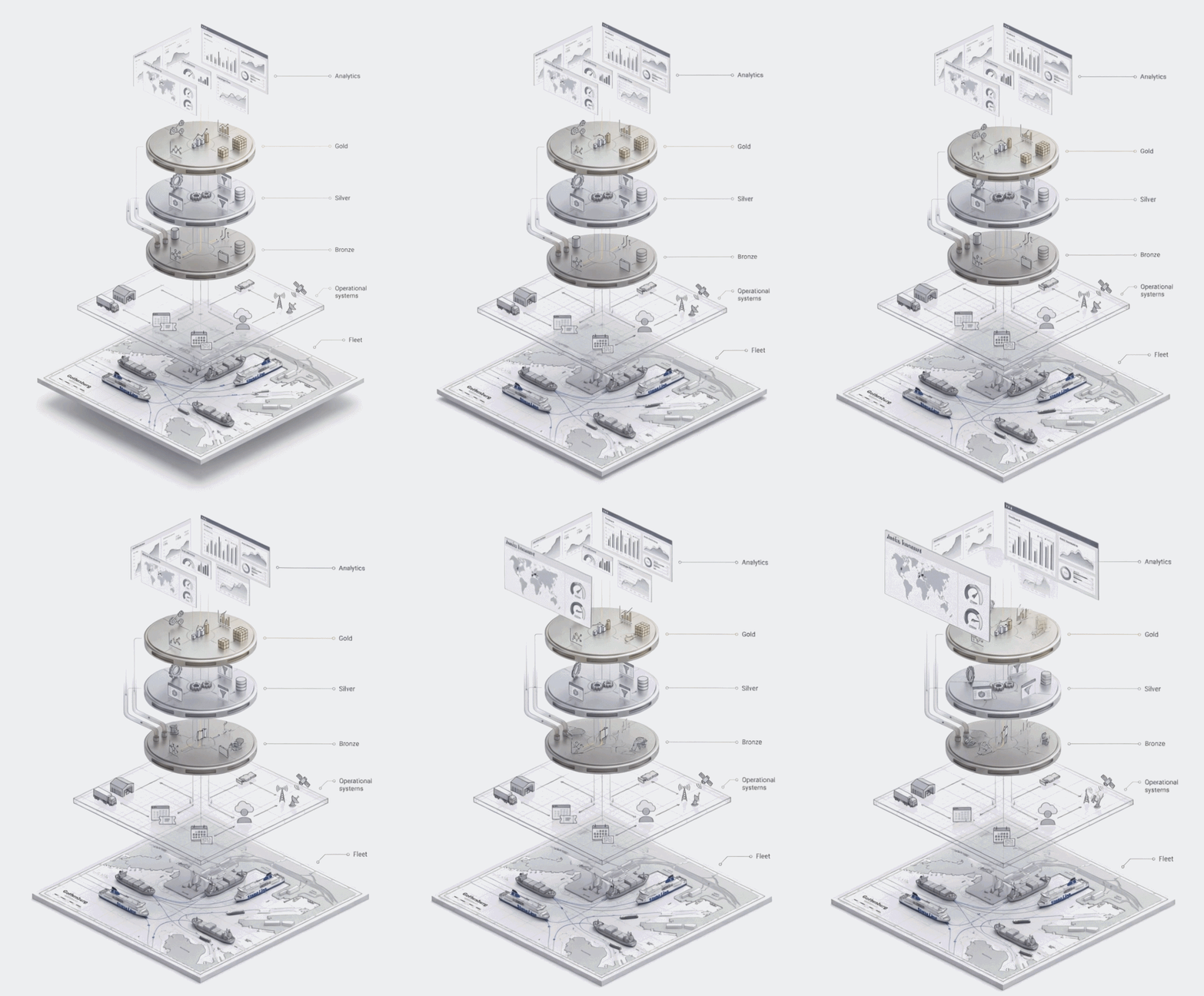
architecture became increasingly difficult to extend efficiently. To support future needs, the teams began migrating towards a modern data lake architecture based on medallion principles using Azure Synapse Analytics. Rather than simply moving existing workloads, the
migration focused on redesigning how data flows through the platform.
Raw data is now ingested into structured landing zones before progressing through refined and curated layers with controlled, traceable transformations. This approach improves governance, simplifies onboarding of new data sources and enables new analytical use cases without disrupting existing reporting.
For analysts, this has meant faster access to new datasets and greater flexibility to answer new business
questions.
A long-term partnership
Over the past three years, the collaboration has evolved from operational support to continuous platform development.
The core Devies team has remained engaged throughout the journey, providing continuity while scaling the team with additional expertise when needed. This has helped ensure resilience, knowledge sharing and steady progress.
At the same time, the platform has continued to evolve. The migration towards a medallion-based architecture has established a stronger foundation for future growth, making it easier to integrate new data sources and support new analytical requirements as Stena Line’s business continues to develop.
The collaboration has been built on shared ownership and complementary expertise. Stena Line
contributes deep knowledge of its business, operations and data, while Devies brings experience in modern data engineering and platform development. Together, the teams have continuously improved the platform while maintaining the stability required for a business-critical solution.
The partnership continues as Stena Line and Devies work together to further develop the platform and support future business needs.