A comparison for leaders who are hiring or buying development capacity, with the trade-offs that job titles hide.
In short
Hire a frontend developer when the user interface, accessibility and performance in the browser or app are the bottleneck. Hire a backend developer when data, integrations, security and scale are the hard part. Choose a full-stack developer for small teams and early products where one person needs to ship complete features end to end.
Job ads for a frontend developer (frontend utvecklare), a backend developer and a full-stack developer often look alike, and the titles mean different things in different companies. This comparison is written by Devies, a Gothenburg-based product and engineering consultancy, for CTOs, product leads and founders who need to decide which role to recruit or buy next. It defines the three roles, compares them side by side and gives concrete signals for when each one is the right next step.
What do frontend, backend and full-stack developers do?
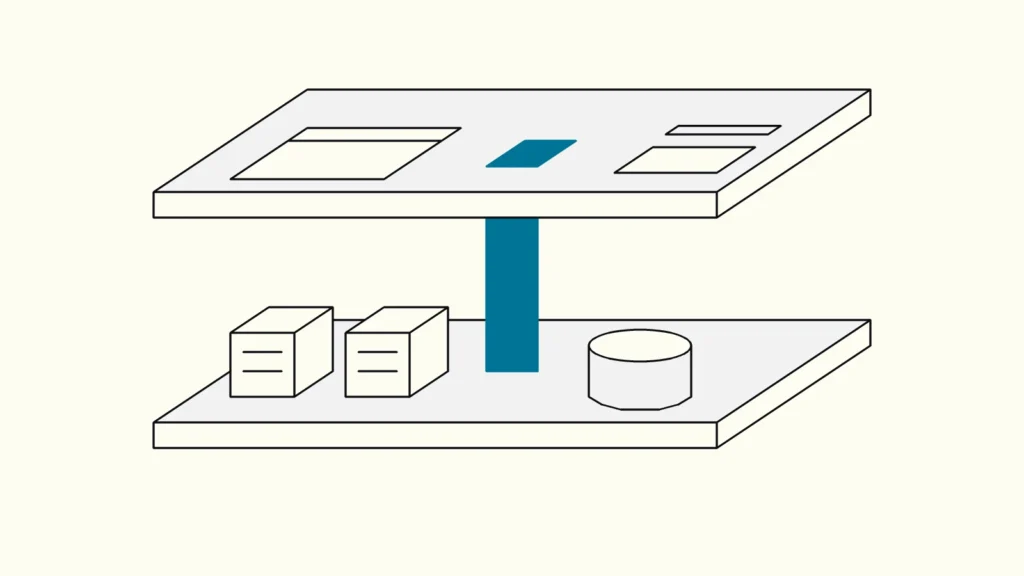
A frontend developer builds what users see and interact with, a backend developer builds the services and data behind it, and a full-stack developer works across both layers. The boundary is the API: frontend code calls it, backend code implements it.
- A frontend developer is a developer who builds user interfaces in the browser or in apps, typically with HTML, CSS, JavaScript or TypeScript and a framework such as React, Vue or Angular. The work includes layout, state handling, forms, performance and accessibility. Accessibility is a real skill here: meeting WCAG 2.2 depends largely on how the frontend is built.
- A backend developer is a developer who builds the server side: APIs, business logic, databases, integrations with other systems, authentication and background jobs, typically in languages such as C#, Java, Python, Go or Node.js. Security weaknesses such as those in the OWASP Top 10 mostly live or die here.
- A full-stack developer is a developer who can deliver a feature across frontend and backend, usually with depth in one side and working knowledge of the other. Very few people are equally strong in both.
Two neighbouring roles are often mixed in. A UX or UI designer decides what the interface should do and look like; a frontend developer makes it work in code. A DevOps or platform engineer builds the pipelines and infrastructure that both frontend and backend code run on.
Frontend, backend or full-stack: a decision table
The right role depends on where your product's hardest problems are, how large the team is and how much of the system already exists. Use the table to compare the options against your situation.
Criterion
Frontend developer
Backend developer
Full-stack developer
Core work
Frontend developer
Interfaces, interaction, browser and app behaviour
Backend developer
APIs, data, integrations, security, performance at scale
Full-stack developer
Complete features across both layers
Typical tools
Frontend developer
TypeScript, React or similar, CSS, testing in the browser
Backend developer
C#, Java, Python or Node.js, SQL, cloud services
Full-stack developer
A mix, usually one stack such as TypeScript end to end
Best fit for
Frontend developer
Customer-facing products where usability drives revenue
Backend developer
Systems with complex rules, many integrations or high load
Full-stack developer
Small teams, MVPs, internal tools
Team size where it shines
Frontend developer
Medium and large teams with a separate backend
Backend developer
Medium and large teams, or data-heavy products
Full-stack developer
One to five developers
Main risk if missing
Frontend developer
Clunky, slow or inaccessible interface
Backend developer
Fragile integrations, security gaps, slow queries
Full-stack developer
Shallow depth when a hard problem appears
Works closely with
Frontend developer
Designers, product owner
Backend developer
Architects, data and operations teams
Full-stack developer
Everyone, often also with deployment
Choose a frontend developer when
- users complain about the interface, or conversion and task completion are the metrics that matter;
- you have a designer or design system and need someone who can turn it into accessible, fast code;
- the backend is stable and well documented, and the backlog is dominated by screens and flows.
Choose a backend developer when
- the product depends on integrations with ERP, CRM, payment or partner systems;
- performance, data quality or security incidents are the current pain;
- you are designing APIs that several clients will use. Our comparison of REST and GraphQL shows the kind of decisions this role owns.
Choose a full-stack developer when
- you are building a first version and need features shipped end to end by few people;
- the system is small enough that one person can understand all of it;
- you already have a specialist and need someone who can cover the other side well enough.
How should you combine the roles in a team?
Most product teams need both perspectives, and the useful question is the mix, not a single hire. A common pattern is to start full-stack and specialise as the product grows.
In an early product, two or three full-stack developers with complementary strengths move fastest, because each feature can be shipped without hand-offs. As the product grows, specialists pay off: a frontend specialist raises the quality of the interface and the design system, and a backend specialist keeps data, integrations and security under control.
Devies saw how far a small, mixed team can go when building SEVR Insights, an AI-supported platform for accounting consultants. According to the case, a team of three developers and one designer took it from concept to a production-ready platform in four months, with design, development and testing running in parallel.
Whatever the mix, three habits keep the layers from drifting apart:
- Agree the API contract first. Frontend and backend can then work in parallel against the same specification.
- Review across the boundary. Let a backend developer review frontend changes that touch data handling, and the other way round. Our guide to code review that does not slow the team describes how to keep this light.
- Own features, not layers. Give a pair or a small group responsibility for a complete feature, so nobody optimises their half at the expense of the user.
Should you hire, contract or buy a team?
Hire permanently for skills you will need for years, and bring in consultants or a team when you need speed, a missing specialism or a temporary peak. The role decision and the sourcing decision are linked, but they are not the same.
A permanent frontend developer builds deep knowledge of your users and design system. A contracted backend specialist can be the right call for a one-off integration project or a security clean-up. If you need a whole feature area delivered, a small team with a mix of roles is often more efficient than assembling individuals. Our comparison of an IT consultant, a development team or project delivery goes through the commercial side of that choice.
Before recruiting, write down the five hardest problems in your next two quarters and mark each as frontend, backend or both. The distribution usually answers the question more reliably than the job titles your competitors use.


Devies
Want a second opinion?
Devies, a Gothenburg-based product and engineering consultancy, works on questions like this with Nordic product and IT teams. Tell us where you are and we will suggest a sensible first step.
Frequently asked questions
What is the difference between a frontend and a backend developer?
A frontend developer builds the part of an application that users see and interact with, such as screens, forms and navigation, mostly in TypeScript and a UI framework. A backend developer builds the services behind it: APIs, business logic, databases, integrations and security. They meet at the API, which the frontend calls and the backend implements.
Is a full-stack developer cheaper than hiring two specialists?
A full-stack developer can be cheaper for small products because one person ships complete features without hand-offs. The saving shrinks as the system grows: hard problems in performance, security, accessibility or complex integrations need depth that generalists may lack. Many teams combine one or two full-stack developers with a specialist on the side where the product's biggest risk sits.
Which role should a startup hire first?
Most early-stage products benefit from a full-stack developer first, ideally one with depth on the side that carries the most risk. If the product is mainly a data or integration service, lean towards backend strength. If the product competes on user experience, lean towards frontend strength. Add specialists once the backlog clearly separates into interface and platform work.
Does a frontend developer need to know accessibility?
Yes. Most accessibility problems, such as missing labels, poor keyboard support, low contrast and unclear focus, are created or fixed in frontend code. A frontend developer who understands WCAG and tests with a keyboard and a screen reader prevents expensive fixes later, and helps companies covered by accessibility legislation meet their obligations.