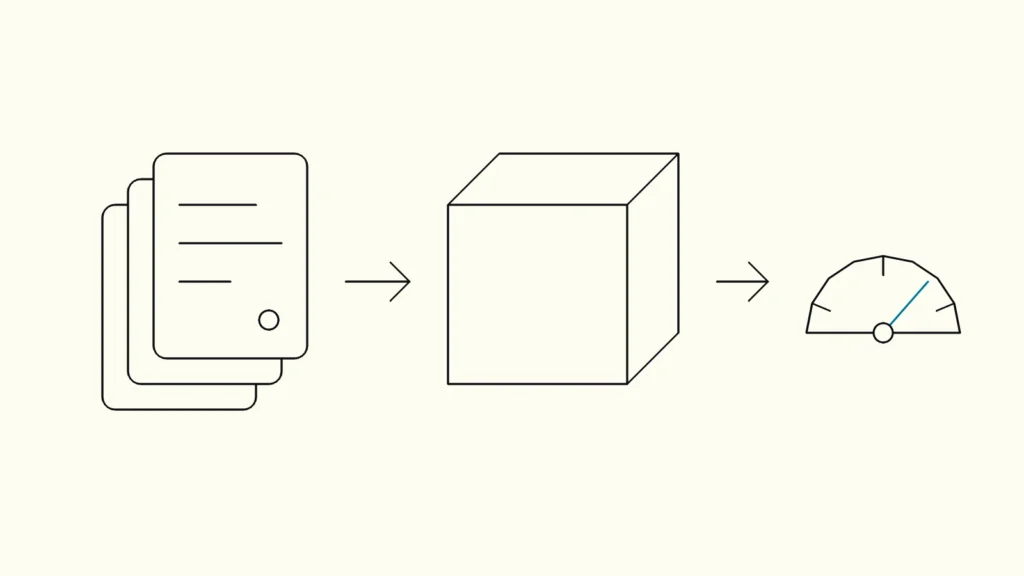
What machine learning is, how it differs from rules and from generative AI, where it pays off, and the questions to ask before you fund a project.
In short
Machine learning is a way of building software that learns patterns from examples instead of following rules a programmer writes by hand. It suits problems with lots of historical data and patterns too complex for rules, such as demand forecasting, fraud detection or document classification. Its output is a probability, so it needs testing, monitoring and a human-owned decision process.
Every software vendor now says its product "uses AI". For a leader deciding where to invest, that phrase hides the questions that matter: what is the model learning from, how good is it, and what happens when it is wrong? This explainer from Devies, a Gothenburg-based product and engineering consultancy, explains machine learning (maskininlärning) in business terms for CEOs, CFOs and heads of operations who need to judge proposals rather than build models.
What is machine learning?
Machine learning is the practice of training software, called a model, to make predictions or generate content by learning patterns from data. Google's introductory course defines it as training a model "to make useful predictions or generate content" from data (Google for Developers).
The difference from traditional software is where the logic comes from. In a rules-based system, a person writes "if the invoice amount exceeds 50,000 kronor and the supplier is new, flag it". In an ML system, you show the model thousands of past invoices labelled "fraud" or "not fraud", and it learns which combinations of features tend to signal a problem, including ones nobody thought to write down.
That gives ML its strengths and its weaknesses. It can capture patterns too subtle or numerous for rules. But it only knows what the data showed it, it can be confidently wrong, and it rarely explains itself the way a written rule does.
How is it different from AI, rules and statistics?
ML is one family of methods within artificial intelligence; it overlaps heavily with statistics and differs from rules-based automation in that the logic is learned rather than written. The terms are often used interchangeably, which causes confusion in budget discussions.
Term
What it is
Example
Rules-based automation
What it is
Logic written explicitly by people
Example
Route invoices over a set amount to a manager
Statistics
What it is
Methods to describe data and quantify uncertainty
Example
Average delivery time with a confidence interval
Machine learning
What it is
Models that learn patterns from data to predict or classify
Example
Predicting which orders will arrive late
Generative AI
What it is
Models that create new text, images or code
Example
Drafting a reply to a customer email
Artificial intelligence
What it is
The umbrella term for systems that perform tasks associated with human intelligence
Example
All of the above except plain rules
In EU law, the definition is broad. As of October 2026, Article 3 of the EU AI Act defines an AI system as a machine-based system that infers from its input how to generate outputs such as predictions, content, recommendations or decisions. Most ML models a company deploys fall inside that definition, so it is worth knowing which of your systems use one.
What are the main types of machine learning?
The main types are supervised learning, unsupervised learning, reinforcement learning and generative models, and most business value today comes from the first and the last.
- Supervised learning learns from examples with known answers. It covers regression, which predicts a number such as next month's demand, and classification, which predicts a category such as "will churn" or "will not churn". This is the workhorse of business ML.
- Unsupervised learning finds structure in data without labelled answers, for example grouping customers into segments or spotting unusual transactions.
- Reinforcement learning learns by trial and error against a reward, as in some robotics, pricing and logistics optimisation. It is rarely the first project for a mid-sized company.
- Generative models, including the large language models behind chat assistants, learn patterns in text, images or code and produce new content.
If the question is "what will happen next?", our explainer on predictive analytics shows how forecasts are built and tested.
Where does it create value in a mid-sized company?
ML creates value where a decision is repeated often, data about past cases exists, and a better prediction changes what someone does. One-off strategic decisions rarely qualify.
Typical examples:
- Sales and marketing: lead scoring, churn prediction, product recommendations.
- Finance: late-payment prediction, anomaly detection in transactions, cash flow forecasts.
- Operations and supply chain: demand forecasting, delivery-time prediction, quality inspection from images.
- Customer service: classifying and routing incoming cases, suggesting answers.
- Maintenance: predicting equipment failure from sensor data.
A simple test is to ask three questions. Is the decision made at least weekly? Do we have a few hundred or more past examples with known outcomes? Would a better prediction change an action, such as an order, a call or an inspection? If the answer to any is no, a report, a rule or a process change may deliver more value for less money. Our guide on how to prioritise AI use cases gives a fuller scoring method.
What should leaders ask before funding an ML project?
Leaders should ask what decision the model improves, how its quality will be measured against today's way of working, what happens when it is wrong, and who will run it after launch. These questions matter more than the choice of algorithm.
- Which decision changes, and by how much? Ask for a baseline: how is the decision made today, and how good is it?
- What data does it learn from? Ask where the history comes from, who owns it and whether it reflects current conditions.
- How will quality be measured? Insist on testing with data the model has not seen, reported in business terms such as missed fraud cases or forecast error in units.
- What is the cost of a mistake? A false alarm and a missed case often have very different costs. The threshold should reflect that.
- Who stays in the loop? For decisions affecting people, such as credit or hiring, keep human review and check the legal rules first.
- Who runs it after launch? Models degrade as the world changes. Someone must monitor accuracy and retrain. The NIST AI Risk Management Framework is a useful voluntary structure for that ongoing risk work.
The sixth question is where many projects fail. A model that worked in a pilot needs data pipelines, versioning and monitoring to survive in production, which is the discipline covered in our explainer on MLOps.
Keep reading

From our work
 Client Case: Stena LineStena Line modernised its Azure data platform - improving Power BI reliability, reducing pipeline runtimes and scaling with medallion architecture.Read the case
Devies
Want a second opinion?
Devies, a Gothenburg-based product and engineering consultancy, works on questions like this with Nordic product and IT teams. Tell us where you are and we will suggest a sensible first step.
Frequently asked questions
What is the difference between AI and machine learning?
Artificial intelligence is the broad field of systems that perform tasks associated with human intelligence. Machine learning is the most widely used approach within it: models learn patterns from data rather than following hand-written rules. Generative AI, such as chat assistants, is built on machine learning too. In practice, most business "AI" today is some form of machine learning.
Do we need a data scientist to use machine learning?
Not always. Many business applications use machine learning inside existing software, such as forecasting in an ERP or spam filtering in email, with no data scientist involved. You need data science skills when you build a custom model on your own data, and you also need data engineering to feed it and someone to run it in production. Many mid-sized companies buy these skills project by project.
How much data does machine learning need?
It depends on the problem. A classification model usually needs at least several hundred examples of each outcome, and more if the pattern is subtle. Forecasting yearly seasonality needs several years of history. Pretrained generative models need far less of your own data, because they were trained elsewhere, but they still need good company content to answer company questions.
Is machine learning regulated in the EU?
Yes, through the EU AI Act, which covers machine-based systems that infer outputs such as predictions or decisions. Most business uses carry light obligations, such as AI literacy for staff. Uses listed as high-risk, for example recruitment or credit scoring, face strict requirements. As of October 2026, those high-risk rules apply from 2 December 2027. Personal data in training also falls under the GDPR.