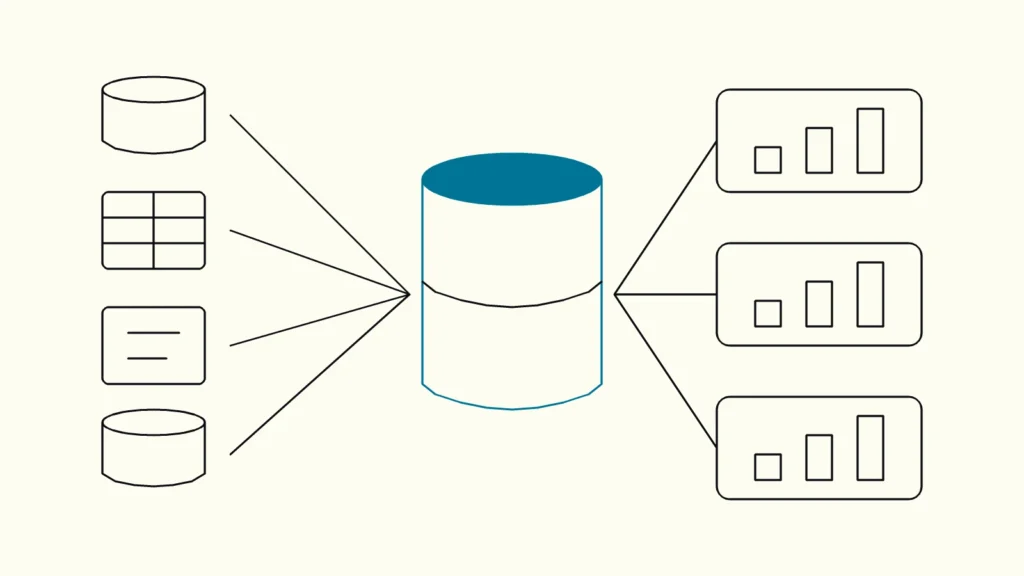
Why "one database for everything" is the wrong goal, what a single source of truth really requires, and the order in which to build it.
In short
A single source of truth is an agreed, authoritative place for each business fact, such as revenue, customer or stock level, so that every report and system gives the same answer. It is not one giant database. You get there by naming owners, agreeing definitions, publishing certified data sets and shared metrics, and retiring the copies people used to trust.
When the sales report and the finance report disagree, meetings turn into arguments about whose spreadsheet is right. The usual reaction is to ask for a single source of truth. This explainer from Devies, a Gothenburg-based product and engineering consultancy, is for CFOs, CIOs and data leads who want to understand what that phrase should mean in practice, and what it costs to achieve.
What is a single source of truth?
A single source of truth (SSOT) is the principle that each important business fact has exactly one authoritative source, and that everyone who needs the fact reads it from there or from a governed copy of it. "One source of truth" is the same idea in looser wording.
Three things make a source authoritative:
- An owner who decides what the fact means and approves changes.
- A definition written down, for example "net revenue excludes VAT and intercompany sales and is booked on invoice date".
- A published location that people can find and that tells them it is the approved version.
The source does not have to be a data warehouse. For customer master data it may be the ERP. For agreed metrics it may be a semantic model. What matters is that the organisation has decided, per fact, where the answer lives.
What it is not, and what it is confused with
SSOT is not one physical database that holds all company data. It is an agreement about authority, supported by technology. The table separates it from ideas it is often confused with:
Concept
What it is
How it relates to SSOT
Single source of truth
What it is
One authoritative answer per business fact
How it relates to SSOT
The goal
Data warehouse or lakehouse
What it is
A platform that stores integrated data for analysis
How it relates to SSOT
Often hosts the governed data, but can still contain conflicting versions
Master data management
What it is
Processes and tools that keep core entities such as customer and product consistent
How it relates to SSOT
Delivers the truth for entities
Semantic layer
What it is
Shared definitions of metrics and relationships used by reports
How it relates to SSOT
Delivers the truth for metrics
Integration
What it is
Moving data between systems
How it relates to SSOT
Spreads the truth, or spreads errors if the source is unclear
A company can have a modern lakehouse and still have five revenue numbers, because three teams calculated revenue differently on top of it. Platform without agreement only centralises the disagreement.
Why do companies end up with many versions of the truth?
Companies end up with many versions of the truth because every system and team solves its own problem with its own copy and its own definitions, and nobody is responsible for reconciling them.
Typical causes:
- Different systems own different parts of a fact. The CRM knows the contract, the ERP knows the invoice and the web shop knows the order.
- Local definitions. Sales counts a customer at signing; finance counts one at first invoice.
- Spreadsheet extracts. A one-off export becomes the monthly report and drifts away from the source.
- Timing. Two reports read the same source at different times of day.
- No visible approval. Users cannot tell an official data set from someone's experiment.
Most of these are organisational, which is why tools alone rarely fix them.
The cost is easy to underestimate. Analysts spend hours reconciling numbers before every board meeting, managers make decisions on figures they quietly distrust, and every new AI or automation project inherits the same confusion. An assistant that answers questions about revenue will give whichever answer its source happens to contain, so conflicting definitions become conflicting answers at machine speed. Counting the hours spent on reconciliation each month is often the simplest way to build the business case.
How do you get to a single source of truth?
You get there one fact at a time: pick the facts that cause the most disputes, assign an owner, agree the definition, publish one certified version and retire the alternatives. Trying to do everything at once is the most common reason SSOT programmes stall.
- List the disputed facts. Ask leadership which numbers cause arguments. Revenue, margin, active customers and stock are usual suspects.
- Choose the system of record for each. Decide where the raw fact is created: ERP, CRM, HR system or production system.
- Name an owner and write the definition. One business person per fact, with a definition short enough to fit in a report tooltip.
- Build one governed version. Integrate the sources into a shared platform and calculate the fact once, in a shared model, rather than in each report. Our explainer on the semantic layer shows how shared metric definitions work.
- Mark it as official. Make the approved version visible. Microsoft Fabric and Power BI, for example, support endorsement badges: "certified" means an authorised reviewer has approved an item, and "master data" marks a data item as the authoritative source for data such as product codes or customer lists.
- Retire the copies. Remove or clearly label old extracts and reports. If they stay, people keep using them.
- Show quality. Display freshness and known issues next to the data, so trust is based on evidence.
For customers, products and suppliers, step 2 to 4 is the core of master data management, which deserves its own programme when many systems create the same entities.
Does a single source of truth mean one copy of the data?
No, it means one authoritative version, which can be read through many tools and sometimes stored in several governed places. Copies are acceptable when they are controlled and traceable to the source.
Modern platforms reduce uncontrolled copying. Microsoft describes OneLake as a single data lake per Fabric tenant, where different analytics engines work on one copy of data in open formats, and shortcuts let teams reference each other's data instead of duplicating it. Features like that help, but they do not decide which revenue definition is correct. That is still an owner's job.
Devies saw this with the City of Gothenburg's planning authority (Stadsbyggnadsförvaltningen). Traffic data came from many sensors and suppliers, each with its own format and assumptions, and departments often worked from different versions. According to the case, Devies built a unified data model, stable pipelines and automated quality checks with anomaly detection, and departments now share one source of truth. The case estimates around 400 hours per year saved on manual data validation.
Keep reading


From our work
 Client Case: Stena LineStena Line modernised its Azure data platform - improving Power BI reliability, reducing pipeline runtimes and scaling with medallion architecture.Read the case
Devies
Want a second opinion?
Devies, a Gothenburg-based product and engineering consultancy, works on questions like this with Nordic product and IT teams. Tell us where you are and we will suggest a sensible first step.
Frequently asked questions
What is an example of a single source of truth?
A common example is revenue. The finance team owns the definition, the ERP is the system of record for invoices, and a certified semantic model on the data platform calculates revenue once. Every dashboard, from the board pack to the sales team's report, reads revenue from that model, so the number is the same everywhere and any change is approved by its owner.
Is a data warehouse the same as a single source of truth?
No. A data warehouse or lakehouse is a place to store integrated data, while a single source of truth is an agreement about which version of each fact is authoritative. A warehouse can hold several conflicting revenue tables. It becomes a trusted source only when owners, definitions, certified data sets and retired alternatives are in place.
How long does it take to establish a single source of truth?
For one disputed fact, such as revenue or active customers, a focused team can usually agree the definition and publish a certified version within weeks if the data is already integrated. Covering all core facts takes longer, often a year or more, because each needs an owner, data integration and the retirement of old reports. Start with the facts that cause the most arguments.
Do we need master data management for a single source of truth?
You need master data management when several systems create or edit the same entities, such as customers or products, and their records disagree. For metrics like margin, a shared semantic model is usually the bigger lever. Many companies need both: master data for consistent entities and a semantic layer for consistent calculations.