What AI is, how it works without the jargon, how it differs from ordinary automation, and what it can and cannot do for a company.
In short
Artificial intelligence is software that learns patterns from data and uses them to produce predictions, content, recommendations or decisions, instead of following only rules a programmer wrote. Most business AI today is machine learning, and the newest wave is generative AI that writes text and code. It is useful, fallible, and in the EU regulated by risk.
Few technology terms are used as loosely as AI. It is printed on spam filters, chatbots, forecasting tools and robot vacuum cleaners, which makes it hard for a leader to judge what is new and what is marketing. This explainer from Devies, a Gothenburg-based product and engineering consultancy, gives a plain answer to the question "what is AI" (vad är AI, in Swedish searches artificiell intelligens) for managing directors, board members and managers who need to make decisions about it without becoming engineers.
What is artificial intelligence?
Artificial intelligence is the field of building computer systems that perform tasks we associate with human judgement, such as recognising images, understanding language, predicting outcomes or writing text, by learning from data rather than following only hand-written rules.
The EU uses a more precise definition. In the AI Act, Regulation (EU) 2024/1689, Article 3(1) defines an AI system as a machine-based system designed to operate with varying levels of autonomy, that may adapt after deployment, and that infers from the input it receives how to generate outputs such as predictions, content, recommendations or decisions that can influence physical or virtual environments. The OECD uses closely aligned wording in its definition of an AI system, revised in 2023.
The key word in both is "infers". Ordinary software does exactly what its rules say. An AI system works out its answer from patterns it has learned, which is why it can handle cases nobody wrote a rule for, and also why it can be confidently wrong.
How does AI work, in plain terms?
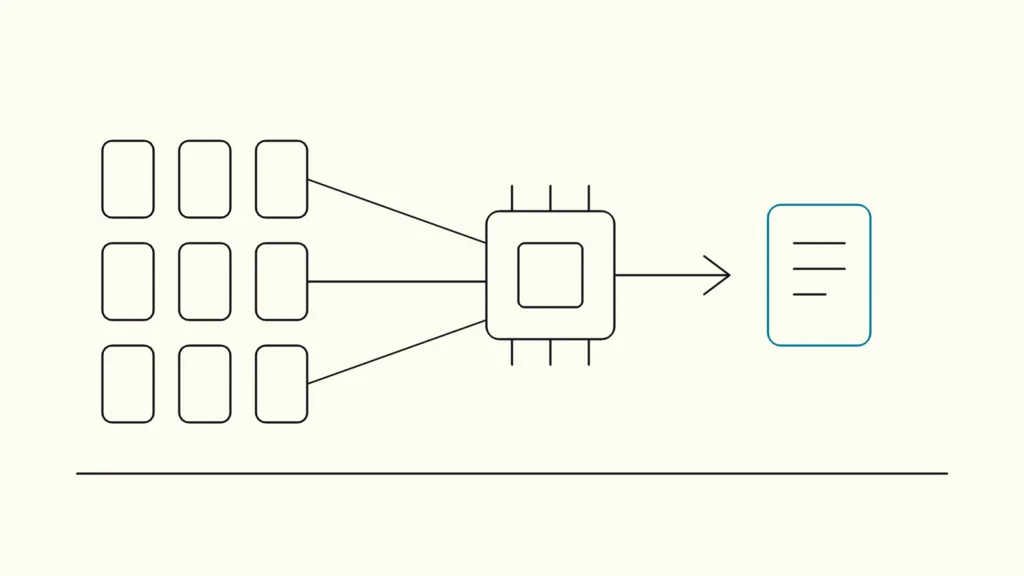
AI works by learning a pattern from many examples during training, and then applying that pattern to new input when it is used. Everything else is a variation on that idea.
Think of a system that sorts incoming invoices. Instead of writing a rule for every supplier and layout, you show it thousands of invoices that people have already sorted. It learns which features predict which category, and it then sorts new invoices it has never seen. The learning step is called training; using the trained model is called inference.
Three terms describe how this is done:
- Machine learning is the branch of AI in which systems learn patterns from data instead of being explicitly programmed. Our explainer on machine learning for business leaders goes deeper.
- Deep learning is machine learning with large neural networks, layered mathematical models that are good at images, sound and language.
- Generative AI is AI that creates new content, such as text, images or code. Large language models, the technology behind tools like ChatGPT and Microsoft Copilot, are generative models trained on very large amounts of text to predict the next word.
This explains the main weakness of generative AI. A language model produces the most plausible continuation, not a verified fact. When it lacks the right information, it can produce a fluent answer that is wrong, often called a hallucination. Good business use gives the model the right sources and checks its output.
AI, automation, machine learning and generative AI: what is the difference?
AI is the umbrella term; machine learning is the main way AI is built today; generative AI is one recent kind of machine learning; and automation is a separate idea that may or may not involve AI.
Term
What it is
Business example
Learns from data?
Rule-based automation
What it is
Software that follows fixed rules written by people
Business example
Invoice approved automatically if under a set amount and matched to an order
Learns from data?
No
Artificial intelligence
What it is
Systems that infer outputs from learned patterns
Business example
Any of the examples below
Learns from data?
Yes
Machine learning
What it is
AI that learns to predict or classify from historical data
Business example
Forecasting demand, flagging likely churn
Learns from data?
Yes
Generative AI
What it is
AI that creates new text, images or code
Business example
Drafting replies, summarising contracts
Learns from data?
Yes
AI agent
What it is
A system that uses a model to plan and carry out steps in other software
Business example
Gathering data from several systems and preparing a case for review
Learns from data?
Yes, plus rules and permissions
Many useful business systems combine them: rules for what must always happen, machine learning for predictions and generative AI for language. The question for a leader is not "do we have AI?" but "which part of this process benefits from learning from data, and which part should stay a fixed rule?"
What can AI do for a company, and what can it not?
AI for companies is most useful on tasks with many repetitive judgements, large amounts of text or data, and a way to check the result; it is least useful where errors are costly and cannot be detected.
Typical places where AI pays off in mid-sized companies:
- Language work: drafting, summarising, translating and searching internal documents.
- Classification: sorting tickets, invoices or leads, and routing them to the right person.
- Prediction: demand, cash flow, maintenance needs or customers likely to leave.
- Extraction: pulling structured data from documents such as orders, contracts and delivery notes.
Our overview of AI use cases by department gives realistic examples for sales, finance, HR and operations.
AI has clear limits that leaders should plan for:
- It does not know your business unless you give it your data, and it can only be as good as that data.
- It makes mistakes in a different way from people. Errors can be confident and inconsistent, so outputs that matter need checks.
- It does not take responsibility. A person or a process must own every decision an AI system supports.
- It costs money to run and maintain. Models, data and usage change, and someone has to monitor quality over time.
A sensible start is to list candidate uses, score them on value, data readiness and risk, and test the best one with real users. Our guide on how to prioritise AI use cases describes that process.
Which rules apply to artificial intelligence in the EU?
In the EU, artificial intelligence is regulated by the AI Act, which sorts AI uses by risk: a few practices are banned, high-risk uses carry strict duties, some uses need transparency, and most everyday AI has no specific obligations.
As of November 2026, according to the European Commission's AI Act page:
- The prohibited practices, such as social scoring and emotion recognition at work or in schools, and the duty to support AI literacy among staff have applied since 2 February 2025.
- General application, including transparency duties for chatbots and generated content, started on 2 August 2026.
- Two further prohibitions, on non-consensual sexual content and on child sexual abuse material, added by the Digital Omnibus on AI, apply from 2 December 2026.
- High-risk rules apply from 2 December 2027 for uses such as recruitment, credit scoring and education, and from 2 August 2028 for AI in regulated products.
The AI Act applies alongside the GDPR, so personal data used by AI systems is still covered by data protection rules. Our article on what the EU AI Act means for your company explains the risk tiers, roles and obligations in more detail.
Keep reading

From our work
 Client Case: HedinFaster loads and clean code: bringing modern software habits to Hedin’s BI platform.Read the case
Devies
Want a second opinion?
Devies, a Gothenburg-based product and engineering consultancy, works on questions like this with Nordic product and IT teams. Tell us where you are and we will suggest a sensible first step.
Frequently asked questions
What is the difference between AI and machine learning?
Artificial intelligence is the broad field of building systems that produce predictions, content, recommendations or decisions by inferring from data. Machine learning is the main technique used to build AI today: the system learns patterns from examples instead of following hand-written rules. All machine learning is AI, but the term AI is also used for older rule-based expert systems and, loosely, for ordinary automation.
Is ChatGPT artificial intelligence?
Yes. ChatGPT is a generative AI application built on a large language model, a deep learning model trained on very large amounts of text to predict the next word. That training lets it write, summarise and answer questions fluently. It does not look facts up by default and can produce plausible but wrong answers, so business use should give it reliable sources and check what matters.
Will AI replace jobs in our company?
AI is more likely to change tasks than to remove whole roles in most mid-sized companies. It takes over parts of work such as drafting, sorting and searching, which frees time for judgement and customer contact. The effect depends on the job and on how the company redesigns its processes. Involving the people who do the work in choosing and testing AI uses gives better results and less resistance.
How should a company get started with AI?
Start with a business problem, not a tool. List tasks where people spend time on repetitive judgements or large volumes of text, check whether the data for them exists and may be used, and choose one use with clear value and manageable risk. Test it with real users against agreed quality criteria, set simple rules for which AI tools staff may use, and train staff in AI literacy.