
Who the law covers, what it requires of websites and apps, how DIGG enforces it, and the first steps for a public body or a publicly funded provider.
In short
The DOS law, lagen om tillgänglighet till digital offentlig service (SFS 2018:1937), requires Swedish public bodies and some publicly funded private providers to make websites and apps accessible. In practice that means meeting EN 301 549, based on WCAG 2.1 AA, publishing an accessibility statement with a feedback function, and answering requests. DIGG supervises.
The DOS law is the Swedish act that implements the EU Web Accessibility Directive, Directive (EU) 2016/2102, for public-sector websites and mobile apps. It entered into force on 1 January 2019. This guide is written by Devies, a Gothenburg-based product and engineering consultancy, for digital, IT and communications leads in municipalities, regions, agencies, schools and care providers who need to know what the law asks of them and where to start.
Digital accessibility (digital tillgänglighet) means that people with disabilities can perceive, operate and understand a digital service. The DOS law turns that goal into enforceable duties. It is separate from the Swedish Accessibility Act, which covers certain consumer products and services under the European Accessibility Act, regardless of whether a public or private actor provides them.
Who does lagen om tillgänglighet till digital offentlig service cover?
The law covers public actors' websites and apps, and the definition of a public actor is broader than government agencies alone.
According to the law text on riksdagen.se, sections 4 and 5, these are covered:
- state and municipal authorities, including municipalities and regions, and their elected assemblies;
- publicly controlled bodies: legal entities serving the public interest that are mainly publicly funded, publicly controlled, or have a board where more than half of the members are appointed by public actors;
- private operators that are partly publicly funded when they run schools, health or dental care, or certain social services;
- private higher-education providers with degree-awarding powers that are mainly state funded.
Some actors and content are outside the law. Section 8 excludes public service broadcasters and non-governmental organisations whose services are not essential to the public or aimed at people with disabilities; that section was rewritten by an amendment in force from 1 January 2026. Section 9 excludes, among other things, live broadcasts of time-based media, maps not intended for navigation, third-party content the actor neither funded, developed nor controls, and certain reproductions of cultural heritage items.
What are the accessibility requirements (tillgänglighetskrav)?
The core requirement is that digital services meet the technical accessibility standard set in DIGG's regulations, which in practice means EN 301 549 and, through it, WCAG 2.1 level AA.
The law itself does not list technical criteria. Section 10 says that services on technical solutions under the actor's control must meet the requirements in regulations. DIGG's regulation states that services conforming to Annex A of EN 301 549 V3.2.1 meet them. That annex maps the standard to WCAG 2.1 AA for web content and to equivalent criteria for documents and apps. As DIGG describes it, content must be perceivable, operable, understandable and robust.
The law adds four duties beyond the technical standard:
Duty
What it means in practice
Section
Accessibility statement
What it means in practice
Publish a statement (tillgänglighetsredogörelse) for each covered website and app, describing how well it meets the requirements
Section
13 §
Feedback function
What it means in practice
Let users report that something is inaccessible or request content in another way, and respond as soon as possible
Section
13 §
Answer requests
What it means in practice
Provide exempted or inaccessible content on a justified and reasonable request without undue delay; give a written, reasoned decision on refusal if asked
Section
15 §
Disproportionate burden
What it means in practice
Requirements can be set aside only if meeting them would be unreasonably burdensome, and that must be stated in the statement
Section
12 §
Disproportionate burden is a narrow exception. Section 12 weighs the actor's size, resources and the estimated costs and benefits against the benefit to people with disabilities. It is not a general opt-out for old systems, and it must be argued case by case.
For technical solutions controlled by a third party, such as a procured platform, section 11 requires accessibility "as far as possible" for services first provided after 22 September 2020. That makes accessibility a procurement requirement, not only a development task.
What are the deadlines, and how is the law enforced?
All transition deadlines have passed, so every covered website and app must comply today.
Service
Deadline
Websites published on or after 23 September 2018
Deadline
23 September 2019
Websites published before 23 September 2018
Deadline
23 September 2020
Mobile apps
Deadline
23 June 2021
As of October 2026, these are the dates DIGG lists, and DIGG is the supervisory authority. Two changes are on the horizon. A new wording of section 4, updating the references to social services legislation, takes effect on 1 January 2027. And EN 301 549 V4.1.1, based on WCAG 2.2 AA, was published in September 2026 but becomes the benchmark only after formal citation; our article on WCAG 2.2 and how to test it explains the difference.
Enforcement is graduated. Under sections 18 and 19, anyone can report a deficiency to DIGG. DIGG first tries to correct problems through notices and dialogue. If that fails, it can order the actor to act, and a repeated order on the same matter can carry a conditional fine (vite). Orders can be appealed to the general administrative court.
First steps: a checklist for public bodies
The fastest route to compliance starts with an inventory and a test of the services people use most, not with a rewrite.
- List every website, app and e-service you provide, including microsites, intranet pages for the public and procured platforms.
- Check whether each one is covered using sections 4, 8 and 9, and note any content exemptions.
- Test the most used services first against EN 301 549 and WCAG 2.1 AA, ideally with WCAG 2.2 AA as the target so you do not test twice.
- Plan the accessibility adaptation (tillgänglighetsanpassning) as backlog items with owners and dates, starting with the barriers that block whole tasks.
- Write or update the accessibility statement with the scope, method and date of review, known deficiencies and a working feedback route.
- Set up a process for requests and reports so that answers arrive quickly and refusals are documented.
- Add accessibility requirements to procurement for every platform, plug-in and app supplier.
- Retest on change and review the statement at least once a year.
Step 3 is where most organisations lose time. An automated scan is a quick start, but the statement needs evidence covering criteria a tool cannot judge, such as keyboard use and screen-reader behaviour. Our WCAG FAQ covers common testing questions in more detail.
Keep reading
From our work
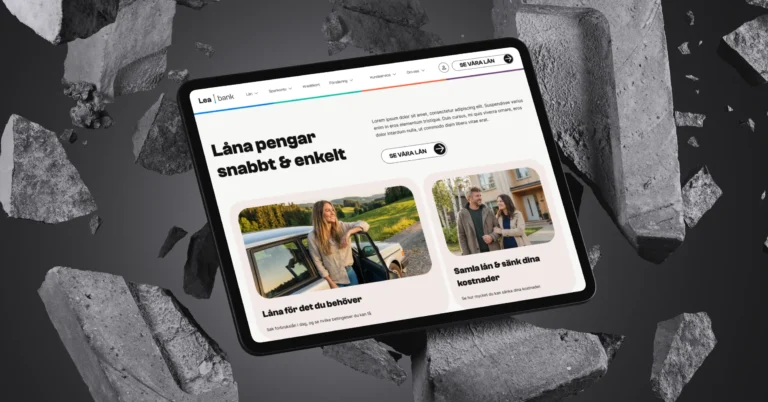 Client Case: Lea BankLea Bank rebuilt its digital platform with Strapi, React, GrowthBook, GA4, and BigQuery to improve SEO, A/B testing, and marketing autonomy.Read the case
Devies
Want a second opinion?
Devies, a Gothenburg-based product and engineering consultancy, works on questions like this with Nordic product and IT teams. Tell us where you are and we will suggest a sensible first step.
Frequently asked questions
Does the DOS law apply to private companies?
Partly. Private operators are covered when they are partly publicly funded and run schools, health or dental care, or certain social services, and some publicly controlled companies are covered as well. Other private companies fall outside the DOS law, but they may be covered by the Swedish Accessibility Act, which implements the European Accessibility Act for consumer services such as e-commerce, banking and passenger transport.
Which WCAG level does the DOS law require?
As of October 2026, DIGG's regulation points to EN 301 549 V3.2.1, which is based on WCAG 2.1 level AA. A newer version of the standard, V4.1.1, is based on WCAG 2.2 AA, but it becomes the formal benchmark only once it is cited. Most public bodies therefore test against WCAG 2.2 AA now, since it also covers every 2.1 AA requirement.
What happens if a public body does not comply?
Anyone can report a suspected deficiency to DIGG, the supervisory authority. DIGG first tries to resolve the problem through notices and dialogue. If that does not work, it can order the organisation to take specific measures, and a repeated order can be combined with a conditional fine. Decisions can be appealed to the general administrative court.
Do PDF documents have to be accessible?
Documents published on a covered website are part of the digital service, and EN 301 549 includes requirements for non-web documents such as PDFs. The EU directive behind the DOS law exempts certain office files published before 23 September 2018 unless they are needed for active administrative processes. Check DIGG's guidance for how that exemption applies to your documents.
Sources
- Lag (2018:1937) om tillgänglighet till digital offentlig service, riksdagen.se
- Förordning (2018:1938) om tillgänglighet till digital offentlig service
- SFS 2025:992, amendment to section 8
- DIGG: Digital offentlig service ska vara tillgänglig
- Directive (EU) 2016/2102 on the accessibility of the websites and mobile applications of public sector bodies
- AccessibleEU: The European accessibility standard EN 301 549 has been updated (7 September 2026)