What master data is, the signs that duplicates and conflicts are costing you, and a small first step that does not start with buying a platform.
In short
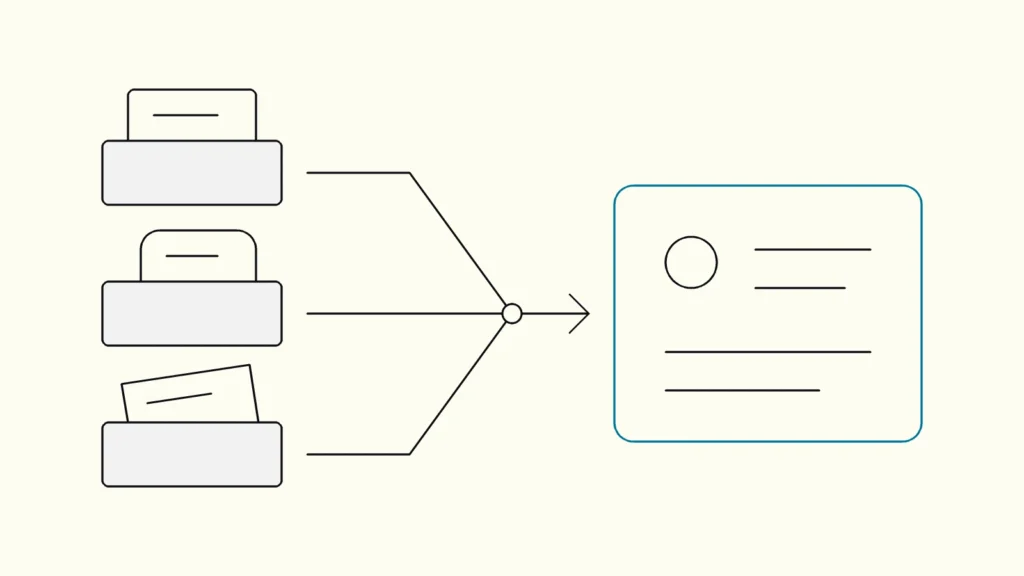
Master data management (MDM) is the discipline and tooling that keeps one agreed, deduplicated version of your core business entities, such as customers, products, suppliers and sites, and shares it with the systems that use them. You need it when the same customer or product lives in several systems with conflicting details, and that costs money, time or trust.
Every company has master data; few manage it on purpose. The customer is created once in the CRM, again in the ERP when the first order arrives, and a third time in the support tool. Each copy drifts. This explainer is written by Devies, a Gothenburg-based product and engineering consultancy that builds data platforms for Nordic companies. It explains what MDM is and is not, when it is worth the effort, which approaches exist, and how to start with one domain instead of a multi-year programme.
What is master data management?
Master data management is the set of processes, roles and tools that create and maintain a trusted reference version of the entities your business runs on, and distribute it to the systems that need it.
Four definitions make the rest of this article easier:
- Master data is the relatively stable data that describes the core entities of the business: customers, products, suppliers, employees, locations and the chart of accounts. Transactions such as orders and invoices refer to it.
- Transactional data is the record of events, such as an order, a payment or a shipment. It changes constantly and always points to master data.
- A golden record is the single, consolidated and cleaned version of one entity, built by matching and merging the copies held in different systems.
- A data steward is the person responsible for the quality of one master data domain, who resolves conflicts the rules cannot settle automatically.
Microsoft's Purview documentation describes the aim well: MDM creates a source of truth by building a deduplicated set of master data records, "a golden standard by which to measure your data". That source of truth only stays true if someone owns it, which is why MDM is as much about roles and rules as about software.
How is MDM different from integration, a warehouse and governance?
MDM decides what the correct version of a customer or product is; integration moves data, a warehouse analyses it, and governance sets the rules all three follow.
The terms overlap in conversation, so it helps to separate them:
Often confused with
What that is
What MDM adds
Data integration
What that is
Moving data between systems through APIs, files or pipelines
What MDM adds
Decides which values are correct before they are moved
ERP integration
What that is
Connecting the ERP to CRM, e-commerce or finance tools
What MDM adds
A shared customer and product identity across all of them
Data warehouse or lakehouse
What that is
A store of historical data for reporting and analysis
What MDM adds
Clean, matched dimensions so reports agree
Data governance
What that is
Policies, ownership and quality rules for data in general
What MDM adds
Applies those rules to the core entities and enforces them
Single source of truth
What that is
A goal: everyone uses the same numbers and definitions
What MDM adds
One of the mechanisms that makes the goal real for core entities
A common mistake is to expect the data warehouse to fix master data. It can match and clean customers for reporting, and that is often a reasonable first step. But the operational systems keep their conflicting copies, so sales, invoicing and support still disagree. MDM becomes relevant when the fix must flow back to where the data is created.
When do you need master data management?
You need master data management when inconsistent core data causes recurring, measurable problems in operations or reporting, not simply because data looks untidy.
Typical signs:
- The same customer exists several times with different addresses, payment terms or credit limits, and nobody knows which is right.
- Product data is entered in more than one place, so prices, units or descriptions differ between the ERP, the webshop and marketplaces.
- Reports disagree on the number of customers, revenue per customer or margin per product, because each source groups entities differently.
- Mergers or new systems bring a second set of customer or supplier numbers that must coexist with the first.
- Regulatory or customer requests, such as GDPR access requests, require you to find every record about one person, and you cannot.
- AI and automation projects stall because models and agents cannot tell whether two records describe the same thing.
If only one or two of these apply, start with clear ownership and a few validation rules in the system where the data is created. If most apply, a dedicated MDM approach usually pays off.
Which MDM approach fits your company?
The right approach depends on where master data is created today and how much you want to change that, and most mid-sized companies should start with the least invasive option.
Four implementation styles are commonly described:
- Registry: systems keep their own data; a central index links matching records with a shared key. Lowest effort, read-only.
- Consolidation: data is copied to a central hub, matched and merged into golden records used for reporting and analytics. Source systems are unchanged.
- Coexistence: golden records are built centrally and synchronised back, so source systems gradually converge.
- Centralised: master data is created and changed only in the MDM hub, which publishes it to every other system. Highest control and highest change effort.
Tooling has also shifted. As of October 2026, Microsoft lists Master Data Services as removed in SQL Server 2025, supported only in SQL Server 2022 and earlier, so companies using it need a migration path. Microsoft Purview integrates with partner MDM tools, currently listing CluedIn, Profisee, Reltio and Semarchy, while Purview itself handles catalogue and governance. In many mid-sized companies the ERP already holds the most reliable product and supplier data, and an ERP integration that publishes it to other systems covers a large part of the need.
How do you start with master data management?
Start with one domain, one business problem and one owner, and prove value in about three months before choosing a platform.
- Pick the domain that hurts most, usually customers or products, and write down the business problem in one sentence.
- Name an owner and a steward. The owner decides the rules; the steward fixes the exceptions.
- Map where the entity is created and used, including spreadsheets.
- Agree a minimal definition: required attributes, the identifier, and which system wins for each attribute.
- Profile the data. Measure duplicates, missing values and conflicts so you have a baseline.
- Build matching and golden records in your existing data platform first, using consolidation, and feed reporting from them.
- Decide what flows back. Only after the golden records are trusted, decide whether corrections should be written back to source systems and whether a dedicated MDM tool is justified.
For the roles and rules around this, see data governance for mid-sized companies.
Keep reading


From our work
 Client Case: HedinFaster loads and clean code: bringing modern software habits to Hedin’s BI platform.Read the case
Devies
Want a second opinion?
Devies, a Gothenburg-based product and engineering consultancy, works on questions like this with Nordic product and IT teams. Tell us where you are and we will suggest a sensible first step.
Frequently asked questions
What is the difference between MDM and a data warehouse?
A data warehouse stores historical data for reporting and analysis, and it can clean and match customers or products for that purpose. MDM maintains the agreed version of those entities for the whole business, including the operational systems where data is created. Many companies start by building golden records in the warehouse, then add MDM processes when corrections must flow back to the ERP, CRM or webshop.
Do we need an MDM tool, or can we start without one?
You can start without one. Ownership, a shared definition, data profiling and matching rules in your existing data platform solve many problems and show where the real conflicts are. A dedicated MDM tool becomes worthwhile when several systems create the same entities, when stewards need workflows to resolve conflicts, or when golden records must be synchronised back to many systems automatically.
What does MDM stand for, and is it the same as mobile device management?
In data work, MDM stands for master data management: keeping one trusted version of core business entities such as customers and products. In IT operations, the same abbreviation means mobile device management, which is software for configuring and securing phones and laptops. The two are unrelated. Check which meaning a vendor or job advert uses before comparing offers.
How long does a master data management project take?
A first domain, such as customers or products, can usually show value in about three months if the scope is limited to one business problem and existing tools. Enterprise programmes covering many domains and synchronising back to every system take much longer. Treat MDM as an ongoing capability with owners and stewards, not a project that ends when a tool is installed.
Sources
- Microsoft Learn, Master data management in Microsoft Purview
- Microsoft Learn, Discontinued Database Engine functionality in SQL Server
- Devies Data Foundation Platform
- Devies Data Hub