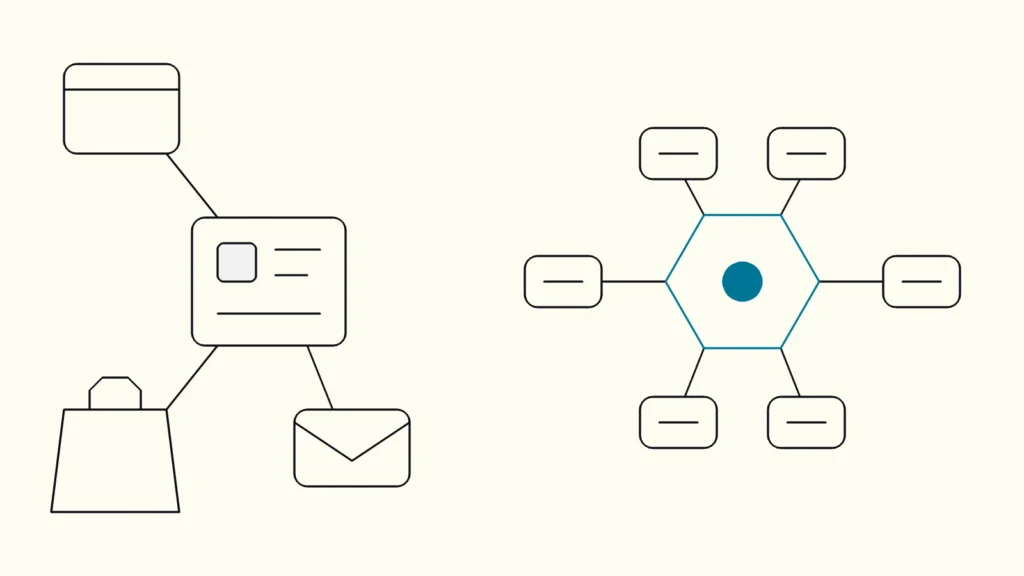
Two kinds of central data platform that solve different problems, how they compare, and when you need one, the other or both.
In short
A customer data platform unifies data about people, such as website visits, purchases and email engagement, into profiles that marketing and service tools can act on. A data hub connects data from across the business, including finance, ERP, operations and HR, into one governed foundation for reporting and AI. Choose by the problem: activating customers, or agreeing on the numbers.
Both a CDP and a data hub promise "one place for your data", which is why they are often weighed against each other. They answer different questions, are usually bought by different departments and need different skills. This comparison from Devies, a Gothenburg-based product and engineering consultancy, is for marketing, data and IT leaders who need to decide which problem they actually have before they commit budget.
What is a customer data platform, and what is a data hub?
A customer data platform (CDP) is software that creates and maintains a persistent, unified customer record that other systems can use; a data hub is a central architecture that collects, cleans and governs data from many business systems so that every team works from the same view.
The CDP Institute defines a CDP as "software that creates and maintains a persistent, unified customer record that is accessible to other systems". The key word is customer. A CDP ingests behavioural and transactional data about people, matches records that belong to the same person, and sends segments and profiles to email, advertising, personalisation and service tools. Microsoft's documentation for its own CDP, Dynamics 365 Customer Insights, describes this unification as deduplication, matching rules across sources and a single profile with a customer ID.
A data hub (sometimes written datahub) has a broader remit. It brings together data about customers, but also orders, invoices, products, stock, projects and employees. It cleans and standardises that data, applies shared definitions and makes it available to reporting, applications and AI. A data hub is usually run by a data or IT team and judged by whether the business trusts the numbers.
How do a customer data platform and a data hub compare?
A customer data platform is built for activating customer relationships, while a data hub is built for a shared, governed view of the whole business. The table sets them side by side on the criteria that usually decide the choice.
Criterion
Customer data platform (CDP)
Data hub
Main question it answers
Customer data platform (CDP)
Who is this customer, and what should we do next?
Data hub
What is true across the business, and can we trust it?
Typical owner
Customer data platform (CDP)
Marketing, e-commerce or customer experience
Data hub
Data, IT or finance together with the business
Core data
Customer data platform (CDP)
Web and app events, purchases, consents, campaign responses
Data hub
ERP, CRM, finance, warehouse, HR and operational systems
Unit of data
Customer data platform (CDP)
The person or account profile
Data hub
Business entities: customers, orders, products, accounts
Main output
Customer data platform (CDP)
Segments and profiles sent to marketing and service tools
Data hub
Curated tables, KPIs and dashboards; data for apps and AI
Speed
Customer data platform (CDP)
Often near real time for personalisation
Data hub
Scheduled or near real time, depending on the use
Typical form
Customer data platform (CDP)
Packaged software, configured
Data hub
Built or assembled on a data platform, then operated
Typical risk
Customer data platform (CDP)
Becoming another silo with its own customer definition
Data hub
Taking on too much before delivering a first useful view
The overlap is customer data. Both will hold a customer table, and if they define "customer" differently you have recreated the problem you set out to solve.
Where does an operational data store fit?
An operational data store (ODS) is a database that integrates current data from several operational systems so it can be queried for day-to-day operations, usually with little history and light transformation. It sits between source systems and analytics, and it is a third option that is easy to overlook.
An ODS suits needs such as a customer service screen showing the latest orders from three systems, or an integration layer that other applications read from instead of calling each source directly. It is not designed for long trend analysis or for marketing activation.
In practice, the three often coexist. A data hub may include an operational layer that serves current data to applications, a historical layer for reporting and a curated layer for KPIs. A CDP can then take its customer and order data from the hub rather than from each source separately, which keeps definitions aligned. For the integration side of that picture, see our article on connecting ERP, CRM and finance systems.
When should you choose a CDP, a data hub or both?
Choose a CDP when the bottleneck is acting on customer behaviour, and a data hub when the bottleneck is that teams cannot agree on the data. Many organisations eventually need both, in that order or the reverse depending on where the pain is.
Choose a customer data platform when:
- marketing needs audiences that update automatically from web, app and purchase behaviour;
- you personalise content or offers in real time and need a profile per visitor;
- consent and preferences must follow a person across channels;
- your business data is already in reasonable order, so the CDP can rely on it.
Choose a data hub when:
- sales, finance and operations report different numbers for the same thing;
- reporting depends on manual spreadsheet work and a few key people;
- you plan to use AI on company data and need a trusted foundation first;
- customer data is only one of several domains, alongside products, orders, finance and staff.
Choose both when you have significant direct-to-consumer marketing and complex internal data. Build or confirm the shared customer and order definitions in the hub, then let the CDP consume them. That way a "customer" in the marketing segment is the same customer finance invoices.
What about GDPR and consent?
Both platforms process personal data, so both need a lawful basis, purpose limitation and data minimisation under the General Data Protection Regulation, which has applied since 25 May 2018. The difference is in emphasis.
A CDP's purpose is to profile and act on individuals, so consent management, preference handling and the right to object to direct marketing are central design questions. A data hub often holds personal data as part of business records, such as customers on invoices or employees in HR data, so access control, retention and keeping personal data out of layers that do not need it matter most. In both cases, decide early which system is the record for consent, so it is not stored in two places with two answers.
Keep reading
From our work
 Client Case: HedinFaster loads and clean code: bringing modern software habits to Hedin’s BI platform.Read the case
Devies
Want a second opinion?
Devies, a Gothenburg-based product and engineering consultancy, works on questions like this with Nordic product and IT teams. Tell us where you are and we will suggest a sensible first step.
Frequently asked questions
Is a CDP the same as a CRM?
No. A CRM is where sales and service teams record and manage relationships: contacts, deals, cases and activities, mostly entered by people. A CDP collects data automatically from many sources, including anonymous web and app behaviour, and unifies it into profiles for other systems to use. Many companies feed CRM data into a CDP, and send CDP segments back to the CRM.
Can a data hub replace a customer data platform?
Partly. A data hub can hold unified customer data and serve segments to other tools, which covers some needs. It usually lacks the packaged features marketers expect from a CDP: real-time event collection on websites and apps, built-in identity resolution for anonymous visitors, audience builders and ready-made connectors to advertising platforms. If those features drive your use case, a CDP on top of the hub is more practical.
What is the difference between a data hub and a data warehouse?
A data warehouse is a store optimised for analytical queries over historical data. A data hub is a broader architecture: it connects source systems, cleans and governs the data, and serves it to reports, applications and AI. A data hub often contains a warehouse or lakehouse as one of its layers, together with pipelines, definitions, access rules and monitoring around it.
Do mid-sized companies need a CDP?
Only if acting on individual customer behaviour across channels is central to revenue, typically in e-commerce, subscriptions or consumer brands. Business-to-business companies with a limited number of known accounts often get more value from clean CRM data and a shared data foundation. Start by listing the decisions or actions you cannot make today, then check which platform removes that specific block.
Sources
- CDP Institute: What is a CDP?
- Microsoft Learn: Data unification overview, Dynamics 365 Customer Insights
- Regulation (EU) 2016/679 (General Data Protection Regulation), EUR-Lex
- Devies: DataHub
- Devies: Data Foundation Platform