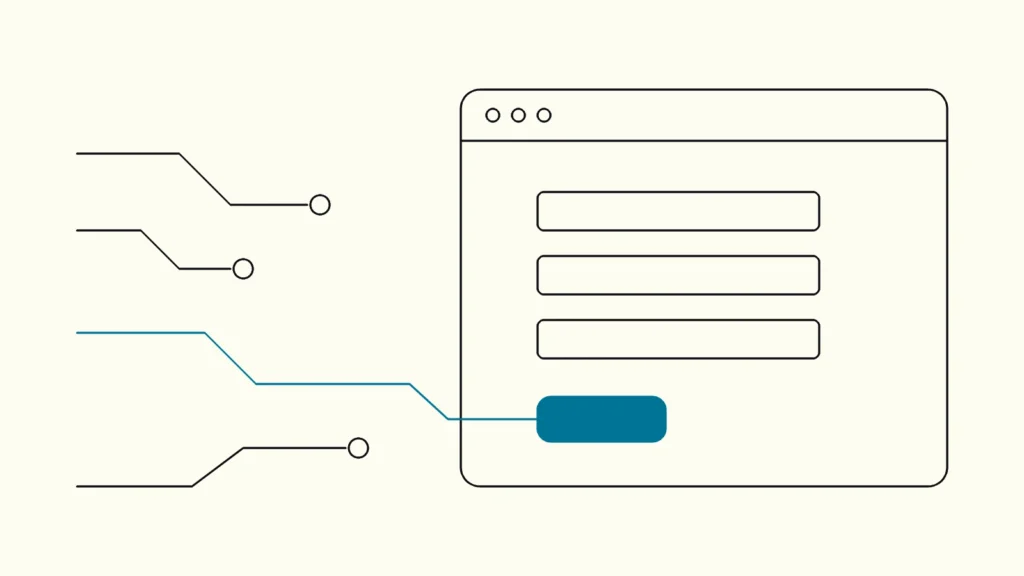
An eight-step method for getting more of the right visitors and users to take the action that matters, without guessing, dark patterns or tests your traffic cannot support.
In short
Conversion optimisation is the systematic work of increasing the share of visitors or users who complete a valuable action, such as a demo request or product activation. In B2B, start by defining the right conversions, find where and why people drop off, fix clear problems directly, and reserve A/B tests for pages with enough traffic.
B2B websites and products rarely lack traffic ideas; they lack a reliable way to turn visits into qualified conversations and active users. This guide from Devies, a Gothenburg-based product and engineering consultancy, is for marketing leads, product owners and founders. It defines conversion optimisation (konverteringsoptimering in Swedish), explains why B2B is different, and gives an eight-step method you can run with a small team.
What is conversion optimisation?
Conversion optimisation is the practice of improving a website or product so that a larger share of its visitors or users take a desired action, based on evidence about what stops them. The same work is often written as conversion optimization in American English or shortened to CRO.
A conversion rate is the percentage of users who take that desired action. Jakob Nielsen's article on conversion rates at Nielsen Norman Group distinguishes two kinds of conversion:
- A macro conversion is a complete action of real business value, such as a purchase, a registration or a subscription.
- A micro conversion is a step of incremental progress towards it, such as opening a pricing page or watching a product video.
In B2B, typical conversions look like this:
Context
Macro conversion
Useful micro conversions
Company website
Macro conversion
Demo or meeting request, qualified contact form
Useful micro conversions
Pricing or case page view, download, newsletter sign-up
Self-service SaaS
Macro conversion
Trial started, then trial converted to paid
Useful micro conversions
Account created, first project set up, colleague invited
Customer portal or app
Macro conversion
Task completed without contacting support
Useful micro conversions
Feature used for the first time, return visit within a week
E-commerce for businesses
Macro conversion
Order placed, repeat order
Useful micro conversions
Quote requested, product added to a saved list
Nielsen also points out that the goal is to optimise the rate, not maximise it at any cost. A form that removes every qualifying question may convert more visitors but send sales a pile of poor leads.
Why is conversion optimisation different in B2B?
B2B conversion optimisation is different because volumes are low, buying cycles are long and the person who converts is rarely the only decision maker. Advice written for consumer e-commerce often fails on all three counts.
- Low volume. A page with 40 demo requests a month cannot show a statistically reliable difference between two versions within a few weeks. Qualitative research does more of the work.
- Long cycles. The visit that converts may come months after the first one. Measure conversions over periods that match your sales cycle and release rhythm.
- Lead quality matters more than count. Ten more requests that sales disqualifies are worse than no change. Connect web conversions to CRM outcomes where you can.
- Several readers. Technical evaluators, buyers and managers look for different things. Clear routes for each, such as documentation, security information and case studies, often matter more than a stronger button.
How do you run conversion optimisation step by step?
Run it as a loop: define, measure, diagnose, change, measure again. These eight steps fit a small team and a modest budget.
- Define one macro conversion per audience. Agree with sales and product what counts, for example "qualified demo request" rather than "any form sent". Write it down with its definition.
- Set up measurement you trust. In Google Analytics 4, actions that matter to the business are marked as key events; Google uses the word conversion for key events used to measure ad campaigns. Check that the events fire once, on success, and note how consent choices affect what you can count.
- Record a baseline. Capture conversion rate and absolute numbers over a period long enough to smooth out weekly and seasonal swings. Nielsen warns that surges of low-quality traffic can distort the rate, so always look at both.
- Find where people drop off. Map the journey from entry pages to conversion and compare step-by-step completion. The largest drop on a high-traffic step is your first candidate.
- Find out why. Analytics shows where, not why. Run a small usability test of the journey, talk to sales and support about recurring questions, and read form error logs. Our guide to usability testing on a budget shows how to do this in a week.
- Prioritise hypotheses. Write each idea as "Because we saw X, changing Y should improve Z", and rank by expected impact, evidence strength and effort.
- Fix clear problems, test uncertain ones. A broken form on mobile does not need an A/B test; fix it. Test only when the evidence is mixed and traffic allows a reliable answer.
- Measure the change and repeat. Compare against the baseline, check lead quality in the CRM, and record what you learned so the team does not re-test the same idea next year.
Which changes usually make the biggest difference?
The changes that most often move B2B conversion are clarity of the offer, shorter forms, visible proof and fewer technical barriers. They are not tricks; they remove reasons to leave.
- Say what you do in the first screen. Visitors should understand who the product is for and what problem it solves within seconds, in their own words rather than internal jargon.
- Cut form fields. Nielsen notes that removing questions usually raises completion. Ask only what sales needs for the first conversation and collect the rest later.
- Show evidence close to the decision. Relevant customer cases, security and compliance information, and clear next steps reduce the risk a buyer feels.
- Make the next step obvious. One primary call to action per page, with a lower-commitment alternative for visitors who are not ready.
- Remove barriers. Slow pages, error messages that do not explain the fix, and forms that cannot be completed with a keyboard or screen reader all lose conversions, and accessibility gaps may also breach legal requirements.
Avoid manipulative patterns such as fake urgency or pre-ticked consent boxes. They may lift a short-term number, but they damage trust, attract the wrong leads and can conflict with consumer and data protection law.
When is A/B testing worth it?
A/B testing is worth it when a page has enough conversions to detect a meaningful difference within a few weeks and when the team is genuinely unsure which version is better. Below that volume, a qualitative study gives a clearer answer faster. To choose the right method for each question, see our comparison of UX research methods.
The infrastructure matters as much as the idea. Devies saw this at Lea Bank, where the marketing team depended on developers for every change. In the Lea Bank digital platform case, Devies rebuilt the site on a headless CMS with a React frontend, connected GrowthBook for A/B testing and GA4 for behavioural tracking, and built a pipeline into BigQuery. The case describes a marketing team that can now publish without developers and run experiments, read results and act on them; it does not report conversion figures.
The lesson for most B2B teams: before buying a testing tool, make sure marketers can change pages quickly and that conversion data is reliable. Otherwise tests stall while waiting for developers or produce numbers nobody trusts.
Keep reading
From our work
 Client Case: Lea BankLea Bank rebuilt its digital platform with Strapi, React, GrowthBook, GA4, and BigQuery to improve SEO, A/B testing, and marketing autonomy.Read the case
Devies
Want a second opinion?
Devies, a Gothenburg-based product and engineering consultancy, works on questions like this with Nordic product and IT teams. Tell us where you are and we will suggest a sensible first step.
Frequently asked questions
What is a good conversion rate for a B2B website?
There is no universal benchmark, because it depends on what you count, your traffic sources and your price point. Nielsen Norman Group notes that typical conversion rates fall roughly between 1 and 10 percent, and that a good rate is one that is higher than your previous rate. Track your own baseline per audience and per conversion type, and judge changes against it.
How long does conversion optimisation take before we see results?
Fixing clear problems, such as a broken mobile form or an unclear offer, can show an effect within weeks. Building a reliable measurement baseline usually takes one or two months, and B2B effects on qualified pipeline can take a full sales cycle to appear. Treat it as continuous work tied to your release rhythm rather than a one-off project.
Do we need A/B testing for conversion optimisation?
No. A/B testing is one tool and needs enough traffic to give reliable answers. Many B2B sites improve conversion mainly through usability testing, customer interviews, analytics and straightforward fixes. Use A/B tests on high-traffic pages where the team is genuinely uncertain, and avoid declaring winners from small samples or short test periods.
Is conversion optimisation the same as SEO?
No. Search engine optimisation brings relevant visitors to your site; conversion optimisation helps those visitors take the next step once they arrive. The two support each other: clear, useful pages tend to serve both searchers and buyers. Measure them separately, because more traffic with the same number of conversions means the conversion rate falls even when the business improves.