Which companies the European Accessibility Act covers, what the Swedish law requires and how you show compliance.
In short
The EAA (Directive (EU) 2019/882) has applied since 28 June 2025. In Sweden it is implemented through the Accessibility Act (tillgänglighetslagen). It covers consumer services such as e-commerce, consumer banking, e-books and electronic communications. Websites and apps should meet EN 301 549, which means WCAG 2.1 AA today, and providers must publish how they comply.
The European Accessibility Act is no longer a future deadline. As of October 2026, the EAA has applied for more than a year, Swedish authorities supervise it, and customers can report barriers. This guide is written by Devies, a Gothenburg-based product and engineering consultancy, for teams that sell digital services to consumers in Sweden and the rest of the EU. It covers who is in scope, what the requirements mean for a website or app, how the law differs from the Swedish public-sector rules, and a practical order of work.
Who does the EAA cover?
The EAA covers a defined list of consumer products and services, not every website. Tillgänglighetsdirektivet, the Swedish name for Directive (EU) 2019/882 on accessibility requirements for products and services, sets out that list, and the Swedish Accessibility Act (SFS 2023:254) repeats it. The Swedish law entered into force on 28 June 2025.
Services are covered when they are intended for consumers:
- E-commerce services: selling products or services to consumers at a distance through a website or app.
- Consumer banking services.
- Electronic communications services.
- Services giving access to audiovisual media.
- E-books and the software used to provide them.
- Parts of passenger transport services by air, bus, rail and water, such as websites, apps, e-tickets and travel information, plus self-service terminals in urban and regional transport.
Products covered include general-purpose computers and operating systems, smartphones, payment terminals, ATMs, ticketing and check-in machines, e-readers and consumer equipment for TV and electronic communications.
Three limits matter when you assess your own position:
- Microenterprises are exempt for services. A microenterprise is a company with fewer than 10 employees and an annual turnover or balance sheet total of no more than EUR 2 million.
- Business-to-business services are outside the scope. A SaaS product sold only to companies is not covered. A company that also sells to consumers online is covered for that consumer service.
- Exemptions must be documented. A provider may argue that a requirement would fundamentally alter the service or be a disproportionate burden, but the law requires a written assessment.
What does the European Accessibility Act require of digital services?
The European Accessibility Act requires covered services to be perceivable, operable, understandable and robust, and requires providers to publish how the service meets those requirements. The directive itself does not name WCAG. It sets functional requirements in its annexes and relies on harmonised standards to make them testable.
For websites and apps, that standard is EN 301 549. EN 301 549 is the European standard for accessibility of ICT products and services, and its web and software clauses reuse the WCAG success criteria. As of October 2026, the version that gives a presumption of conformity is V3.2.1, built on WCAG 2.1 level AA. ETSI published EN 301 549 V4.1.1 in September 2026, which moves to WCAG 2.2 and adds an annex mapped to the directive, but it only gives that presumption once the Commission cites it in the Official Journal. A sensible target for new work is therefore WCAG 2.2 AA: it contains almost everything in 2.1 AA and prepares you for the next citation.
In practice the requirements turn into work in four areas:
Area
What it means for a web shop or app
Interface
What it means for a web shop or app
Keyboard access, visible focus, sufficient contrast, text alternatives, zoom and reflow, labelled forms and clear error messages
Journeys
What it means for a web shop or app
The whole flow must work: search, product page, basket, checkout, payment, login and account pages
Identification and payment
What it means for a web shop or app
Login, security and payment steps must be perceivable, operable and understandable
Information
What it means for a web shop or app
A description, in the terms and conditions or on a dedicated page, of how the service meets the requirements
The information requirement is often missed. The Swedish law says the service provider must produce the information needed to show how the service meets the accessibility requirements, and Annex V of the directive describes what it should contain. It is a different document from the public-sector accessibility statement, but the structure can be similar.
Third-party components count too. If the checkout, chat or cookie banner comes from a supplier, it is still part of your service. Ask suppliers for their conformance information and test the integrated result, not the component in isolation.
DOS-lagen vs the EAA: which law applies to you?
DOS-lagen applies to public-sector websites and apps, while the Accessibility Act applies to listed consumer services whoever provides them. DOS-lagen, also searched as "dos lagen", is the Swedish Act on accessibility to digital public services (SFS 2018:1937). It implements the Web Accessibility Directive and has applied in full since 2021.
DOS-lagen
Accessibility Act
Who
DOS-lagen
Public bodies and some publicly funded organisations
Accessibility Act
Providers of listed consumer services; manufacturers, importers and distributors of listed products
What
DOS-lagen
Websites, apps and documents
Accessibility Act
Listed products and services, including the whole consumer journey
Technical benchmark
DOS-lagen
EN 301 549 V3.2.1, Annex A
Accessibility Act
Harmonised EN 301 549, currently V3.2.1
Public documentation
DOS-lagen
Accessibility statement (tillgänglighetsredogörelse) with a feedback function
Accessibility Act
Information on how the service meets the requirements
Supervisor in Sweden
DOS-lagen
DIGG, the Agency for Digital Government
Accessibility Act
PTS and other authorities by sector
DIGG's guidance on digital public services confirms that the public-sector law requires levels A and AA. Some organisations fall under both laws, for example a regional transport authority selling tickets in an app. One test basis can then serve both, but the documentation and the supervisors differ.
Who supervises the Swedish Accessibility Act?
PTS, the Swedish Post and Telecom Authority, supervises e-commerce, consumer banking and electronic communications services, and other authorities cover the remaining sectors. As of October 2026, the ordinance that complements the law (SFS 2023:676) divides supervision of services like this:
- PTS: e-commerce, consumer banking and electronic communications. PTS also coordinates when several authorities are affected.
- Mediemyndigheten (the Swedish Agency for the Media): services giving access to audiovisual media.
- Myndigheten för tillgängliga medier (MTM): e-books.
- Konsumentverket and Transportstyrelsen: different parts of passenger transport services.
Supervisors can order a provider to correct deficiencies, and the law allows sanction fees. Reviews can start from a complaint, a market survey or a planned inspection, so a visible barrier in a checkout is exactly the kind of issue that leads to questions. What you will be asked for is evidence: test scope and results, the published information, any documented exemption and a plan for known gaps.
Roadmap: how to show EAA compliance
The quickest route to defensible compliance is a scoped assessment of your most important consumer journeys, followed by fixes, retesting and published information. Work in this order:
- Confirm scope. List the services you offer to consumers and match them to the categories in the law. Check the microenterprise threshold if relevant, and write the conclusion down.
- Choose the benchmark. Test against EN 301 549, which means WCAG 2.1 AA today. Use 2.2 AA as the target for new design and development.
- Map critical journeys. For e-commerce: find a product, add to basket, check out, pay, log in and contact support. Include error states and third-party components.
- Screen automatically, then test manually. Tools find a share of problems quickly. Keyboard use, screen readers, zoom and clarity of text need people, and W3C states that human evaluation is required.
- Prioritise by user impact. A blocker in payment outranks a contrast issue on a campaign page.
- Fix in shared components. Correcting a design-system button or form field fixes many pages at once.
- Retest and document. Keep test dates, scope, results and remaining gaps. File any disproportionate-burden assessment with them.
- Publish and maintain. Publish the required information with a way for customers to report barriers, and retest at major releases.
Keep reading
From our work
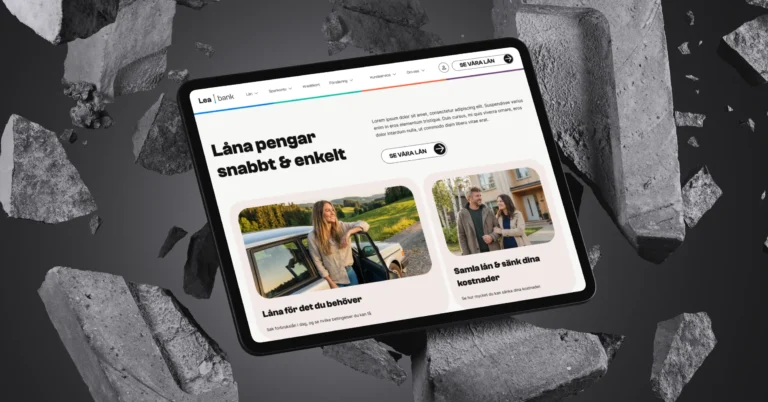 Client Case: Lea BankLea Bank rebuilt its digital platform with Strapi, React, GrowthBook, GA4, and BigQuery to improve SEO, A/B testing, and marketing autonomy.Read the case
Devies
Want a second opinion?
Devies, a Gothenburg-based product and engineering consultancy, works on questions like this with Nordic product and IT teams. Tell us where you are and we will suggest a sensible first step.
Frequently asked questions
Does the European Accessibility Act apply to B2B companies?
Only for services offered to consumers. The Swedish Accessibility Act covers the listed services "when they are intended for consumers", so a platform sold only to businesses is outside its scope. A company that sells mainly to businesses but also runs a web shop open to private customers is covered for that web shop. Check each service separately and record the reasoning, because supervisors will ask how you reached the conclusion.
Is there a transition period until 2030 for existing websites?
Not in the way it is often described. The transitional rule lets service providers keep using products they were already using before 28 June 2025, until 27 June 2030 under the Swedish law, and self-service terminals for up to 20 years. It is not a general grace period for a web shop or app. Treat consumer-facing websites as covered now, and confirm any reliance on the transition rule with legal counsel.
Do we need WCAG 2.1 or WCAG 2.2 to meet the EAA?
As of October 2026, the harmonised standard that gives a presumption of conformity is EN 301 549 V3.2.1, which is based on WCAG 2.1 level AA. The newer V4.1.1, published in September 2026, is based on 2.2 AA but needs to be cited in the Official Journal before it carries the same legal effect. Building to 2.2 AA now covers both and avoids rework.
Are small companies exempt from tillgänglighetslagen?
Microenterprises that provide services are exempt from the accessibility requirements for those services. The Swedish law defines a microenterprise as a company with fewer than 10 employees and an annual turnover or balance sheet total of no more than EUR 2 million. The exemption does not apply to products, so a small manufacturer of a covered product still has obligations. Larger companies cannot use the exemption for a single small service.
Sources
- Directive (EU) 2019/882 on the accessibility requirements for products and services
- Lag (2023:254) om vissa produkters och tjänsters tillgänglighet
- Förordning (2023:676) om vissa produkters och tjänsters tillgänglighet (supervision, sections 28-31)
- AccessibleEU: The European accessibility standard EN 301 549 has been updated (7 September 2026)
- ETSI EN 301 549 V4.1.1 (2026-09)
- DIGG: Digital offentlig service ska vara tillgänglig
- W3C WAI: Evaluating Web Accessibility Overview