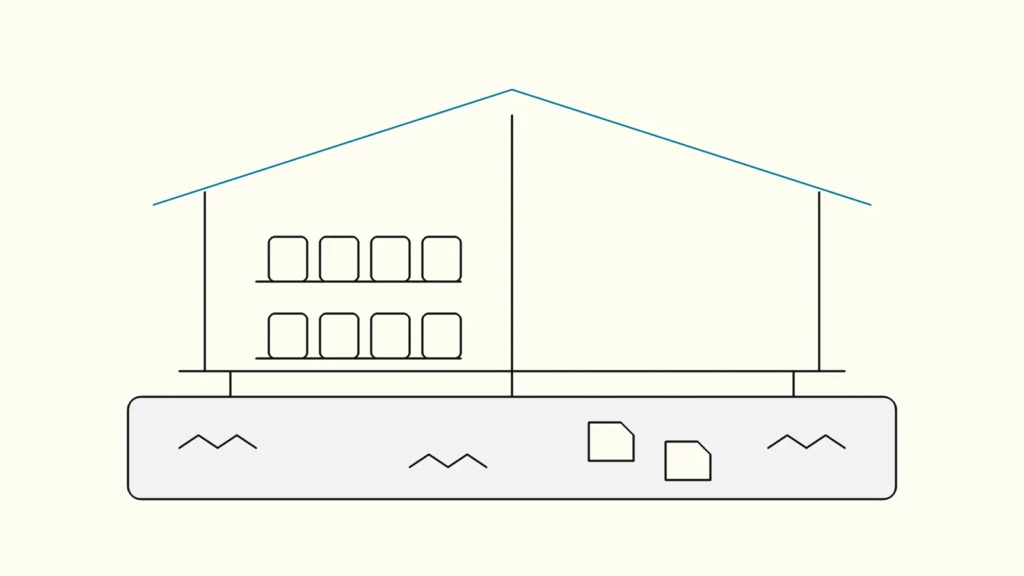
A side-by-side comparison of the two architectures on data types, skills, cost, governance and AI, with clear guidance on when each one is the better choice.
In short
Choose a data warehouse when your data is mostly structured, your team works in SQL and the main job is trusted reporting. Choose a lakehouse when you also handle files, logs or semi-structured data, want data science and AI on the same copy of the data, or want open table formats. On modern platforms, many companies end up using both.
The choice used to be a big architectural bet. Today the major platforms offer both a warehouse and a lakehouse on the same storage, so the question is less "which product" and more "which way of working fits our data and our team". This comparison is written by Devies, a Gothenburg-based product and engineering consultancy that designs and runs data platforms for Nordic companies. It is for CTOs, data leads and finance or operations managers who are about to commit budget to a data platform and want the trade-offs in plain terms.
What are a data warehouse, a data lake and a data lakehouse?
A data warehouse is a structured, SQL-first store for reporting; a data lake is cheap storage for raw files; and a data lakehouse combines lake storage with warehouse features such as tables, transactions and access control.
- A data warehouse (datalager) is a database designed for analysis, holding cleaned, structured data in tables with a defined schema, queried with SQL and usually feeding BI tools.
- A data lake is low-cost object storage that keeps data in its original form: CSV, JSON, Parquet, images, logs. It is flexible but, on its own, offers no transactions or table-level guarantees.
- A lakehouse is an architecture that stores data in open file and table formats on lake storage and adds warehouse capabilities on top: ACID transactions, schema enforcement, SQL access and governance.
- A data fabric is an architectural approach that connects data across many stores through shared metadata, catalogues and integration services. It describes how distributed data is found and governed, not where it is stored.
The term lakehouse was set out in a 2021 CIDR paper by Armbrust, Ghodsi, Xin and Zaharia, which argued that open formats on lake storage could address warehouse problems such as stale data, cost, lock-in and limited support for machine learning. If you want the layering inside a lakehouse, the bronze, silver and gold pattern, that is a separate topic.
How does a data lakehouse compare with a data warehouse?
The two differ most in the data they handle well, the skills they assume and how open the storage is; for plain structured reporting, they perform similar jobs.
Criterion
Data warehouse
Lakehouse
Best-fit data
Data warehouse
Structured tables from ERP, CRM and finance
Lakehouse
Structured plus semi-structured and unstructured: files, events, logs, documents
Primary skills
Data warehouse
SQL, data modelling, BI
Lakehouse
Python or Spark plus SQL; data engineering
Transactions
Data warehouse
Full multi-table transactions are standard
Lakehouse
ACID per table through the table format; multi-table support varies by platform
Storage format
Data warehouse
Often proprietary, managed by the engine
Lakehouse
Open table formats such as Delta Lake or Apache Iceberg
Machine learning and AI
Data warehouse
Data usually exported to separate tools
Lakehouse
Data science works on the same copy of the data
Governance
Data warehouse
Mature, table and column level
Lakehouse
Available on modern platforms; needs deliberate setup across files and tables
Typical users
Data warehouse
Analysts, finance, report builders
Lakehouse
Data engineers and data scientists, with analysts via SQL endpoints
Main risk
Data warehouse
Rigidity and cost as data variety grows
Lakehouse
Turning into an unmanaged data lake without discipline
Microsoft's decision guide for Fabric reduces the first choice to three questions: do you develop in Spark or T-SQL, do you need multi-table transactions, and is your data structured only or also unstructured? In Fabric, both options store data in Delta format in OneLake and share the same SQL engine, which shows how far the two have converged.
When should you choose a warehouse, and when a lakehouse?
Choose by the data you have and the team you have, not by which architecture is newer.
Choose a data warehouse when:
- most of your data comes from structured business systems such as the ERP, CRM and finance;
- the main goal is consistent reporting and KPIs in a BI tool;
- your team is strongest in SQL and data modelling;
- you need multi-table transactions and mature, well-understood access control;
- you have no near-term plans for machine learning on large volumes of raw data.
Choose a lakehouse when:
- you also need to store and analyse files, sensor or event data, logs or documents;
- data science, machine learning or retrieval-augmented AI should work on the same data as reporting;
- you want open table formats to keep the option of changing query engines later;
- data volumes are large or growing fast and you want storage priced like a data lake;
- you have, or will build, data engineering skills.
Use both when analysts need a SQL-first warehouse for curated reporting while engineers ingest and refine data in a lakehouse. Microsoft's guide explicitly lists pairing the lakehouse with a warehouse for enterprise analytics as a recommended use. For many mid-sized companies this is the end state: a lakehouse for ingestion and refinement, and a warehouse or gold layer for the numbers the business signs off on.
Where do Azure Synapse and data fabric fit?
Azure Synapse is an existing Microsoft analytics service that combines warehouse and lake tools, while data fabric is a design approach rather than a product.
Azure Synapse Analytics brings together dedicated and serverless SQL pools for data warehousing, Apache Spark, data integration pipelines and Power BI integration. Many Nordic companies built their first cloud data platform on it. As of October 2026, Microsoft's own documentation steers new warehouse work towards Microsoft Fabric: it publishes a migration guide from Synapse dedicated SQL pools to Fabric Data Warehouse with an automated migration assistant. If you run Synapse today, there is no need to panic, but a new investment should account for that direction. Plan the move with lift-and-shift or phased modernisation, as the guide describes, rather than as a rushed rewrite.
Data fabric is often confused with Microsoft Fabric because of the name. A data fabric connects data where it lives, through shared metadata and governance, and can include warehouses, lakehouses and operational databases. It is useful when data must stay in many places, for example after acquisitions. It does not replace the decision about how your central analytics store is built.
What should you decide before you choose?
Decide on the questions the architecture must answer before you compare platforms, because the same data platform can be built either way.
Use this checklist in your first planning meeting:
- List the top ten business questions the platform must answer in its first year.
- Inventory data sources and types: which are structured tables, which are files, events or documents.
- Assess the team: SQL and BI skills, Python and Spark skills, and who will run the platform after launch.
- Clarify AI ambitions for the next two years: none, reporting only, machine learning, or AI assistants on company data.
- Set governance requirements: personal data, access control by role or region, audit needs.
- Check existing investments, such as Synapse, on-premises SQL Server or Power BI, and their migration paths.
- Estimate cost drivers: storage volume, compute patterns and licences, rather than list prices.
- Pick a pilot of one domain, such as sales or finance, and build it end to end before scaling.
Once the architecture is clear, the vendor choice follows. For that comparison, see Microsoft Fabric, Databricks or Snowflake.
Keep reading
From our work
 Client Case: HedinFaster loads and clean code: bringing modern software habits to Hedin’s BI platform.Read the case
Devies
Want a second opinion?
Devies, a Gothenburg-based product and engineering consultancy, works on questions like this with Nordic product and IT teams. Tell us where you are and we will suggest a sensible first step.
Frequently asked questions
Is a data lakehouse replacing the data warehouse?
Not entirely. Lakehouse platforms now handle much of what warehouses did, and the original lakehouse paper predicted that shift. In practice, platforms such as Microsoft Fabric offer both on the same storage, and many companies use a warehouse for curated, SQL-based reporting alongside a lakehouse for ingestion, data science and AI. The warehouse concept, structured and governed data for decisions, remains; the storage underneath has changed.
Is a data lakehouse more expensive than a data warehouse?
Not necessarily. Lakehouse storage is usually cheaper because it uses object storage, but compute costs depend on how much processing you run and how well it is managed. A warehouse can be cheaper for small, purely structured reporting workloads. Compare total cost over three years for your own workload, including skills and operations, rather than storage prices or list prices alone.
Should we migrate from Azure Synapse now?
Not in a rush. Synapse remains a documented Azure service, but as of October 2026 Microsoft's documentation steers new warehouse work towards Microsoft Fabric and provides a migration guide and assistant for dedicated SQL pools. Inventory what you run on Synapse, check compatibility, and plan the move as part of your normal roadmap, starting with workloads that would benefit most from the new platform.
What is the difference between data fabric and Microsoft Fabric?
Data fabric is a general architectural approach: it connects data across many systems through shared metadata, catalogues and governance, without moving all of it to one place. Microsoft Fabric is a specific software-as-a-service analytics product that includes a lakehouse, a warehouse, pipelines and Power BI on one storage layer. Microsoft Fabric can be part of a data fabric, but the terms are not interchangeable.
Sources
- Armbrust, Ghodsi, Xin, Zaharia: Lakehouse: A New Generation of Open Platforms that Unify Data Warehousing and Advanced Analytics, CIDR 2021
- Microsoft Learn, Warehouse and Lakehouse: a decision guide (Microsoft Fabric)
- Microsoft Learn, What is Azure Synapse Analytics?
- Microsoft Learn, Migration strategy and planning for Azure Synapse dedicated SQL pools to Fabric
- Devies Data Foundation Platform
- Devies Data Hub