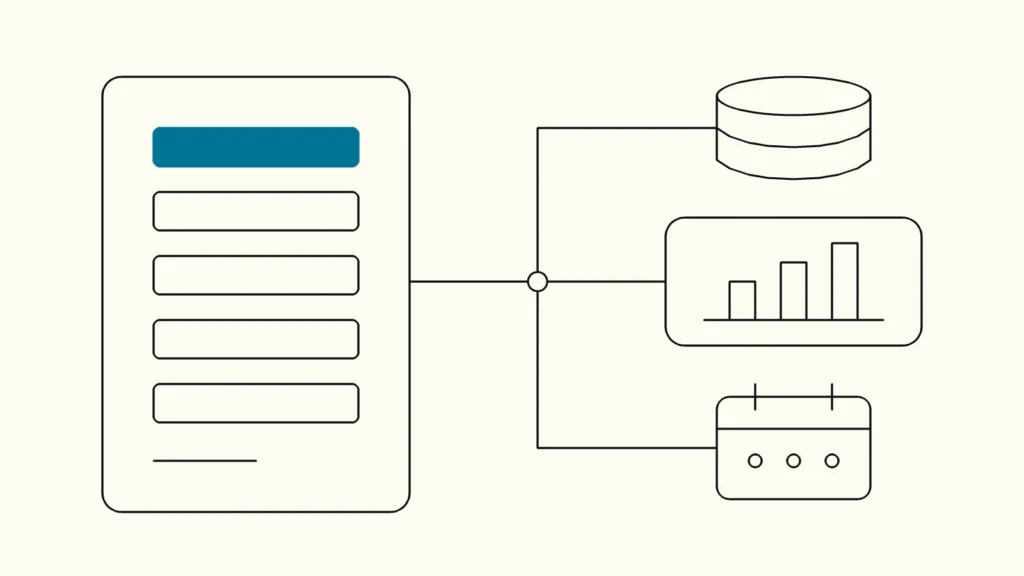
How to write a data strategy that names the decisions you want to improve, the data behind them, who owns it and what you will build in the next twelve months.
In short
A data strategy is a short, written choice about which business decisions data should improve, which data those decisions need, who owns that data and what you will build first. For a mid-sized company it fits on one page: three to five priority decisions, their data sources, named owners, the platform you need and a twelve-month plan.
Most mid-sized companies do not lack data. They lack an agreed answer to "what is all this data for?". Without that answer, every department buys its own tool, reports disagree and AI pilots stall on data nobody trusts. This guide from Devies, a Gothenburg-based product and engineering consultancy, shows CEOs, CFOs and IT leaders how to write a data strategy (datastrategi) on a single page and keep it alive, without a six-month consulting exercise.
What is a data strategy, and what is it not?
A data strategy is a decision about where data should create business value, and what the company will do, in what order, to make that happen. It is a business document with technical consequences, not a technical document with a business preface.
It helps to separate it from the documents it is often confused with:
Document
What it answers
Typical owner
Data strategy
What it answers
Which decisions and processes should data improve, and what do we build first?
Typical owner
CEO or CFO with the IT lead
Data governance
What it answers
Who owns, defines and approves each data set?
Typical owner
Data owners and stewards
Data architecture
What it answers
Which platforms, pipelines and models do we use?
Typical owner
IT or data lead
AI strategy
What it answers
Where can AI create value, and with which data?
Typical owner
Business and IT together
BI roadmap
What it answers
Which reports and dashboards are built when?
Typical owner
BI team
The strategy sits on top. Governance, architecture and the BI roadmap carry it out. If your current "strategy" is a list of tools, it is an architecture plan, and it will not tell you what to stop doing.
Why one page is enough for a mid-sized company
A one-page strategy works because a mid-sized company has a few decisions that matter and a small team to act on them. Forty pages describe everything and prioritise nothing.
A short strategy is also easier to defend. When a department asks for a new reporting tool, the page answers whether it serves one of the priority decisions. When the board asks what the data budget buys, the page shows it.
The pressure to choose is real. Statistics Sweden reports that 35 percent of Swedish companies with ten or more employees used AI in 2025, and that among companies that considered AI but did not adopt it, lack of skills was the most common obstacle, with data protection and access to data also frequent barriers. The strategy is where you decide which of those barriers to remove first.
Seven steps to a one-page data strategy
Write the strategy in seven steps, each producing one short block of the page. Plan for three or four working sessions with the leadership team and the people who run the core systems.
- Name three to five priority decisions. Start with business decisions, not data. Examples: "Which customers are at risk of leaving this quarter?", "How much stock do we need per warehouse next month?", "Which projects are losing margin?". If a decision cannot be named, it does not belong on the page.
- List the data each decision needs. For every decision, write the sources: ERP, CRM, finance, web analytics, production systems or spreadsheets. Mark where the data is missing, late or disputed.
- Name an owner for each key data set. One person per data set decides what "customer", "order" or "margin" means and approves changes. Ownership is the cheapest fix in the whole strategy, and the most often skipped.
- Describe the target state in three sentences. For example: "Finance, sales and operations read margin from the same model. Data is updated daily. Every report shows its source and owner." Avoid tool names here.
- Choose the platform capability, not the brand. Decide what you need: a shared data platform, integrations between core systems, a semantic layer for shared metrics, or simply better ERP reports. The tool choice follows in the architecture work.
- Set the rules you must follow. Personal data falls under the GDPR principles in Article 5, such as purpose limitation and data minimisation. As of October 2026, the EU Data Act has applied since 12 September 2025; it gives users of connected products rights to their data and makes it easier to switch cloud provider, which matters if you sell or buy connected equipment.
- Write a twelve-month plan with three milestones. One quick win within three months, one foundation piece within six, and one measurable business result within twelve. Assign each to a named person.
The result fits on one page: decisions at the top, data and owners in the middle, target state, platform and rules below, and the plan at the bottom.
How do you connect the strategy to the data platform?
The strategy connects to the platform through the priority decisions: each decision should map to specific pipelines, models and reports, so you can trace any platform cost back to a business reason.
This is where many strategies fail. The page says "become data-driven" (datadriven), and the platform team builds whatever is asked for loudest. Instead, ask the data team to show, for each priority decision, where the data comes from, how fresh it is and which report uses it. Gaps become backlog items with a business owner attached.
Platform reliability belongs in the strategy too. Devies saw this at Hedin Mobility Group, where an embedded data engineer helped the BI team switch a financial pipeline that reloaded all history on every run to incremental loads, and move infrastructure to code. According to the case, affected financial data loads dropped from over an hour to 10 to 15 minutes. A strategy that promises daily margin figures depends on that kind of foundation work.
How do you keep the strategy alive?
Keep the strategy alive by reviewing it every quarter against the twelve-month plan and changing it when the business priorities change. A page that nobody reads after the kick-off is not a strategy.
A simple routine works for most mid-sized companies:
- Quarterly review, 60 minutes. Leadership checks the milestones, adds or removes one decision at most, and confirms owners.
- Monthly data owner check-in. Owners report open definition disputes and quality problems that block a priority decision.
- One metric per decision. For example, forecast error for stock planning or days to close the books for finance. If the metric does not move, ask why before adding scope.
Ownership and definitions are covered in more depth in our guide to data governance without the bureaucracy. The habits that make people actually use data, from meeting rituals to roles, are the subject of building a data-driven organisation.
Common mistakes to avoid
- Starting with a tool purchase and writing the strategy afterwards.
- Listing twenty priorities, which means none.
- Leaving data ownership to IT, which cannot decide what a business term means.
- Treating AI as a separate strategy, when it depends on the same data and owners.
Keep reading
From our work
 Client Case: Stena LineStena Line modernised its Azure data platform - improving Power BI reliability, reducing pipeline runtimes and scaling with medallion architecture.Read the case
Devies
Want a second opinion?
Devies, a Gothenburg-based product and engineering consultancy, works on questions like this with Nordic product and IT teams. Tell us where you are and we will suggest a sensible first step.
Frequently asked questions
How long should a data strategy be for a mid-sized company?
One page is enough for most companies with up to a few hundred employees. It should name three to five priority decisions, the data each needs, an owner per key data set, the target state, the platform capability and a twelve-month plan. Supporting detail, such as architecture diagrams and definitions, can live in separate documents that the page links to.
Who should own the data strategy?
A member of the leadership team, usually the CEO, CFO or COO, should own the data strategy, with the IT or data lead as co-author. Business ownership matters because the strategy prioritises decisions and budgets. If IT owns it alone, it tends to become a list of tools and platforms instead of a set of business choices.
What is the difference between a data strategy and an AI strategy?
A data strategy decides which business decisions data should improve and what foundation to build. An AI strategy decides where AI should create value. They depend on the same data, owners and platform, so for a mid-sized company the AI ambitions are best written as one or two priority decisions inside the data strategy rather than as a separate document.
How often should we update our data strategy?
Review it every quarter against the twelve-month plan, and rewrite it once a year or when business priorities change, for example after an acquisition or a new product line. The quarterly review should be short: check milestones, confirm owners and change at most one priority decision. Frequent small adjustments keep the strategy relevant without restarting the work.